For better or worse, and probably mostly worse, I’ve always been drawn to fictious characters who can best and most charitably be described as antiheroes.
Frankly, some of them are real shitheads. Heels. Loveable scumbags. Rogues and rakes and rascals. People you’d probably not care to spend much time with in real life. But on the page and on the screen, I find them delightful in their scheming libertine debauchery … and perhaps I’d have lived a better life without them informing my character over the decades, but here we are. Some worship Jesus and Atticus Finch. I prefer Dionysus.
Harry Flashman: I was a high school freshman when a slightly eccentric history teacher — I was fortunate to attend a school that offered electives such as military history and Sino-Soviet history in 1988 — introduced me to the Flashman novels. The main character is a fictional Victorian military hero with a lengthy career filled with bravery, adventures, decorations for heroism, and run-ins with figures both famous and infamous. The conceit, however, is that he’s a complete fraud, elevated for fame and adoration by fortunate circumstances beyond his control. Flashman is a coward, cheat, liar, and degenerate ladies man, a cad and schemer. Yet he’s also brilliant and self-aware, quickly picks up languages, and is sometimes forced to do the right thing and brave thing by forces beyond his control, all of which conspires to create his public reputation as a hero of the ages. The character of Flashman was originally a minor bully in the preachy idealistic 19th century boys novel Tom Brown’s School Days and in the 1960s the Scottish journalist and World War II veteran George MacDonald Fraser took that character and fleshed out his life in a series of novels written as if they’re Flashman’s confessional memoirs discovered in a 1960s estate sale. What’s genius about them is not only their first-person POV and writing, but how Fraser fits Flashman into historic events without changing history. A series of footnotes helpfully explain the events and real figures and how Flashy could have fit in. The novels are hilarious — they’re ribald Victorian era adventures told by an intelligent shitheel at the end of his life on the eve of World War One. By today’s standards, Flashman would be canceled, but keep in mind that these are the fictional memoirs of a 19th century stiving Englishman who is forced to do things he’d rather not (he’d prefer to gamble, drink, gossip, scheme, and fuck everything he can get his hands on, and usually does). The books are Flashman unburdening himself of a (mostly) unearned life of adulation, and they do not really valorize his bad behavior while not being moralistic. He also relishes bursting the glowing reputations of cherished figures. Flashman’s list of female conquests (and yes, some are unfortunately conquests in the ugliest sense) runs 400 long, by his count. Fraser’s writing as Flashman penning his tell-all memoir leaves you entertained as this fraud navigates to save himself through the First Afghan War in the 1840s, Crimean War, American Civil War and Gold Rush, intrigues in Europe, Russia, Africa, Asia … it’s a tour de force of that century’s great events and persons, with Flashman unwillingly at the center of them. There are unexpected surprises, and Flashman’s blunt assessments of his contemporaries are echoed in today’s bitchy celebrity gossip rags and tweets. There are a dozen novels that make up The Flashman Papers, starting with Flashman in 1969 through Flashman On the March in 2005. Fraser died in 2008, and I will forever be sad he didn’t leave us more of old Flashy.
Sebastian Dangerfield: He’s the oddball antihero protagonist of the infamous 1955 picaresque novel “The Ginger Man” by Irish-American novelist J.P. Donleavy. The book was a scandal at the time and banned because it’s about the sexual and comic misadventures of charmingly roguish American college student Sebastian Dangerfield in post-war Dublin. Dangerfield doesn’t want to go to class or work, mooches off friends, womanizes, and generally is someone you’d end up disliking in real life when you were away from them (cleaning up their messes) but cannot help but enjoy them in person. I read the novel while attending college in Dayton, Ohio, and didn’t know until decade later that Dangerfield was based partly on the Dayton-born friend of Donleavy’s, an alcoholic Bohemian named Gainor Crist. Small world. The novel, which has sold more than 45 million copies and is the only really successful book out of many written by Donleavy, has inspired legions of fans and a serious literary academic interest. It’s nearly become a movie several times, and it’s criminal that it has not. The iconic Irish novelist and brawler Brendan Behan, whom Donleavy nearly came to drunken blows with outside a pub (so so so on-brand for both men), loved the book and had broke in Donleavy’s house to edit it — leaving notes that Donleavy followed after cleaning up the ransacked mess Behan left behind. What a fitting birth to this literary masterpiece that includes a scene in which Dangerfield doesn’t realize his dick has fallen out of his pants on the bus.
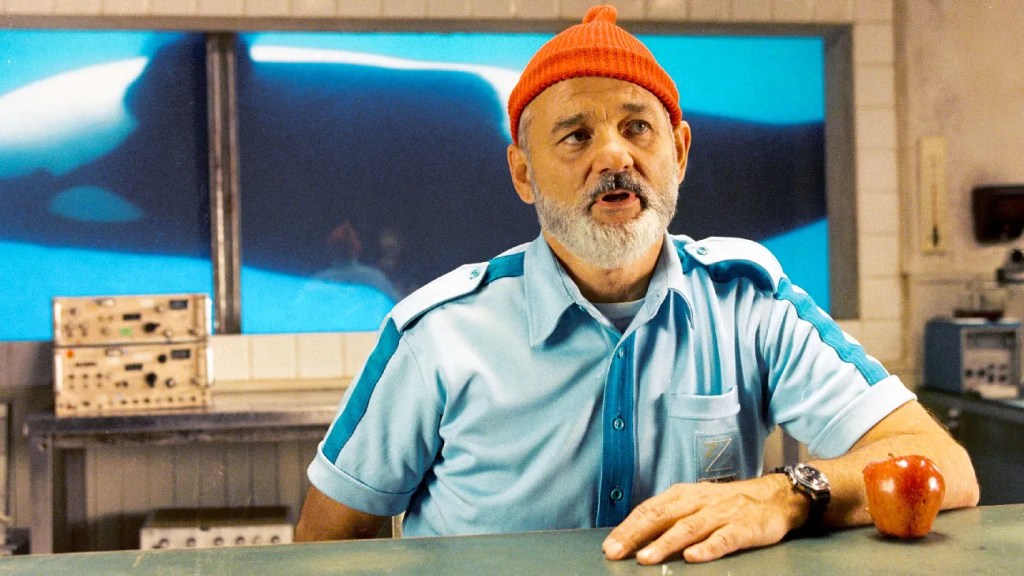
Steve Zissou (pictured at top): He’s the protagonist of Wes Anderson’s “The Life Aquatic With Steve Zissou” played by Bill Murray as a sort of down-market Americanized version of Jacques Cousteau. I happen to think this is Anderson’s best film of those I’ve seen, before he descended into what feels like unintentional self parody. Anyway, I saw this when it came out 20 years ago and I enjoyed the hell out of it. But Zissou didn’t register with me then, when I was thirty, as he does today. Murray and Zissou were both 52 years old in the film, and now I’m almost halfway through age fifty … the character hits home in ways both comfortable and disturbing. Zissou is basically suffering through a mid-life crisis. His wife left him. He’s not made a hit oceanography documentary in almost a decade, and his most recent films clearly are half-assed. Money is tight. His ship is a bit ragged, and so is his loyal crew of misfits. His rival, played to perfection by Jeff Goldblum, is an arrogant wealthy success. Zissou feels washed up and tired. He is beginning to recognize and accept that he’s self-absorbed and selfish, and worries his talent has abandoned him. He feels regret. He has survivor’s guilt and is anguished and vengeful over the death of his best friend. He’s depressed and feeling his years. Zissou is fragile, and wants to recapture his past glory one more time. He’s too old for the journalist love interest played by then-35 years old Cate Blanchett. He has mixed feeling about fathers and fatherhood that’s central to the story. There’s an obvious Ahab element to Zissou, but he doesn’t let the obsession get the best of him, he never really loses his wonder and his empathy, and he’s able to self reflect amid the pathos. “People are going to think I’m a showboat, and a little bit of a prick. But then I thought … that’s me. I said those things, I did those things. I can live with that.” Excuse me while I put on my red knit cap and strap on my Glock (interns have to share one).
Clark W. Griswold Jr.: I grew up living “National Lampoon’s Christmas Vacation” in more ways than I care to remember. And I’m not sure I’ve identified more with a character than Clark Griswold, even if I fail to live up to his frustrated mediocrity as a family man. I do certainly live up to his Charlie Brown-like frustrations and defeats. The Christmas lights, the house filled with decorations, the mission to make a holiday the best and most fun. He’s among the beleaguered fictional middle-aged men/suburban dads in which I find myself reflected: Al Bundy, Bob Belcher, Peter Griffin, Homer Simpson, Fred Flintstone, etc. We’re a trope, but a living, breathing accurate one. Tired, frustrated, beat up by American life, filled with cynical wisdom and real knowledge, and way too many obscure facts about the Civil War and World War II (the French Revolutionary and Napoleonic Wars for me).
Phil Elliott: This is the main character from the satirical and critical football novel “North Dallas Forty” (and uneven but good 1979 movie adaption, played by Nick Nolte). Written in 1973 by former Dallas Cowboys wide receiver Peter Gent, the story is about the horrific physical and mental toll the game takes on players, and was one of the first to pull back the curtain on American’s favorite gladiatorial bloodsport to show the brutality, cruelty, hypocrisy, drugs, sex, and ugliness of it. I played a bit of football in my time, and got to experience first-hand the absurdity and stupidity and comedy of it with a minor league arena team in 2006-07, with a team that won a championship while behind the scenes it was a mix of “M*A*S*H” and “Fear & Loathing In Las Vegas” and “Animal House” and “Caligula” and “North Dallas Forty.” By then, I was aware of the dark underbelly of pro football and experiencing a taste of it firsthand led me to name my son Elliott because no character, to me, embodied the best and worst of the game. He’s also named for T.S. Eliot and Jackson Pollock because all my heroes are brilliant messes.
Hank Moody: David Duchovny starred as the horny cynical New York novelist-turned-Hollywood screenwriter/blogger/script doctor/biographer in the Showtime series that ran from 2007-14. In a sense, Moody is the avatar of many writer’s dream — writing a bestseller and then getting the Tinseltown golden riches, the blockbuster movie adaption. And of course, it goes sideways. Moody’s character — when he finishes a book, he smokes weed, drinks whiskey, and listens to Warren Zevon — is your standard charming rogue and womanizer, but a closer read reveals that while he does bed many women, it’s not under false pretenses and he’s rarely the instigator. He’s up front with them and he never cheats. The heart of the series is his desire to get back with his wife, who is sometimes an unlikeable two-dimensional caricature, which is an unfortunate lapse by the writers. He also struggles as a part-time father. Moody, while a bit of a walking Steely Dan character, is generally likeable and gets into various hilarious capers, occasionally some drama, but you cheer for him. It’s sort of the ultimate mediocre middle-aged white writer guy fantasy. Very few of us look like David Duchovny, however, and could not get away with some of his antics. I admit my reading of his character and the show, which began its shark-jumping arc after Season 3, may be more charitable than it should be.
Sir John Falstaff: One of Shakespeare’s better characters, Falstaff is a fat, narcissistic, dissolute old buffoon and chiseler who is young Prince Hal’s close friend and drinking partner among London’s tavern lowlifes and petty criminals in Henry IV, Part I, and is eventually rejected by the new sober and courtly monarch in Henry IV, Part II. While he’s a comic character with his witty lines and failed schemes, he’s certainly a true heel but a sympathetic one (who had apparently genuinely earned his knighthood in his youth) and Hal’s ultimate rejection of him feels like an indictment of the ruling class always turning its back on its true roots. You can probably see a theme with me preferring debauched, rakish characters like Falstaff and Flashman.
Hunter S. Thompson: He was obviously a very real person, but his literary persona “Raoul Duke” eventually came to overtake the deeply intelligent, witty, gentlemanly, quiet and thoughtful real Thompson. The public and publishers wanted the drugged-out whiskey-soaked wild man of Gonzo Journalism, and that became the character he felt forced to play. Thompson, by all accounts, was a functional alcoholic and didn’t enjoy being around sloppy drunks or anyone zonked out on drugs when he was sober. I get that feeling. Those who knew and worked with him closely have talked and written about his intense commitment to justice, his broad knowledge of literature and politics and the world. But the pressure to become the Clown Prince of Gonzo took its toll. Cocaine burned him out, ravaging his body and mind while years of alcohol did its simultaneous ugly work. He was plagued by an inability to churn out new work, and his later columns often were the work of helpers. He could still crank out the occasional shining gem, but his best years were the 1960s and ’70s. His book in the 1972 presidential campaign remains a masterwork of political writing and insight that echoes today. His 1967 book on the Hell’s Angels was a pre-Gonzo bestseller that hinted at his coming style that exploded with the 1970 magazine story on the Kentucky Derby and later with his Las Vegas adventures — a book that unfortunately gets read as a drug and booze journey when it’s actually an indictment into the death of the American dream. It’s so much more profound than grass, acid, and booze on the Strip. But frat boys aren’t known for their intellectual processing skills, and many young men attempt to model their lives and writing after Thompson, and it’s always a terrible idea. I’m thankful I initially came to HST in my early twenties via his early political and cultural writing in the omnibus “The Great Shark Hunt” rather than the drug stuff. I didn’t get drunk for the first time until I was 32 and didn’t get stoned until my forties. Thompson used his vices as a tool to deliver a message, and it sucks so few recognize that. Or know that he wrote stone sober. I miss his voice in our wretched age today. I keep a Dunhill cigarette in a Targard filter on my desk as a reminder of him while I write, and I have several pieces of HST artwork and other totems around. He was the right north star for me, but it took me awhile to hear the music he was really playing.
The rest of my rogue’s gallery: Larry Darrell; Capt. Benjamin Franklin “Hawkeye” Pierce and Capt. “Trapper” John Francis Xavier McIntyre; sportswriter Oscar Madison; Capt. Jack Sparrow; Henry “Hank” Chinaski; Joe Gideon; Redmond Barry; Randall Patrick McMurphy; Al Bundy; Han Solo; Willie Soke; Kenny Powers; Snake Plisskin; The Dude; Withnail; Col. Walter E. Kurtz; Ignatius J. Reilly; Opus the Penguin; Spider Jerusalem; the very real Sir John Wilmot, 2nd Earl of Rochester; Eve Babitz; Oscar Wilde; Hemingway and Fitzgerald; Lord Byron; Jack Kerouac and several Beats; Paul Bowles; Dorothy Parker; Tallulah Bankhead; Tennessee Williams; Gore Vidal; Truman Capote; Christopher Hitchens; Samuel Coleridge; George Orwell; Edgar Allen Poe; Tom Wolfe; Graham Greene; W. Somerset Maugham; Henry Miller and Anais Nin; William Burroughs; de Sade; Aleister Crowley; Ken Kesey; Aldous Huxley; Albert Camus; George Plimpton; Charles Baudelaire; Arthur Rimbaud; Patti Smith; Jimmy Buffett; Kenny Stabler; Dylan Thomas; and Jim Morrison.
As a final note, I need to say that there was a time in my twenties and thirties, when I was an especially selfish unthinking dipshit (aka moderate Republican), that I much more literally admired genuinely harmful scumbags like Tucker Max, P.J. O’Rourke, and William F. Buckley Jr., and I sometimes behaved like some of the rakehells above. I do not recommend it because the price is enormous. One can be a decadent Bohemian libertine without being an asshole to those who least deserve it. Be an asshole to rich shitheads.
-30-
 Unpaid Bills
Leave a comment