Living in the sprawl,
Dead shopping malls rise like mountains beyond mountains,
And there’s no end in sight,
I need the darkness someone please cut the lights.
– From Arcade Fire’s 2011 song “Sprawl II (Mountains Beyond Mountains)”
I am a child of shopping malls.
I grew up with them, created memories inside them, and reached my peak with them. And now, we’re both in decline but hanging on as best we can.
My mother managed a mall store when I was a teenager, both my siblings worked mall retail jobs in the early Eighties, and I got dropped off for shopping mall dates before I got my driver’s license. And after getting that license, my first car accident was in a mall garage (no damage but my teenage heart was PUMPING). I bought cassette tapes and my first compact discs at malls. My senior year, a bunch us sat for a goofy photo on a mall Santa’s lap. It was the full “Fast Times at Ridgemont High” life.
I must have spent thousands of hours as a kid or young adult in malls. So why can’t I remember these places in detail? I know it’s a function of the human brain’s capacity for processing memory, but it’s strange that I endlessly walked the concourses of these enormous shopping cathedrals and now so much memory of them is lost. Like most kids, I looked but didn’t see. There was no reason to stop and really examine my mall surroundings. To look closely. There was no time to smell the roses – I had to get to the bookstore or the tape store or meet my buddies at the arcade or grab a sandwich at Swenson’s.
Some of what I do remember of malls is fuzzy, and I often conflate one mall memory for another. Was that Hickory Farms store in South Hills Village mall, or was it in Tri-County Mall before its renovation? Which mall had Thom McAn? Gadzooks? Contempo Casuals? Merry-Go-Round? Chess King? Fashion Bug? These are my losing battles with memory and age.
Why do I care? I miss it. That’s nothing unusual, to harbor fond nostalgia for our rapidly retreating youth when the world and our lives still held such promise. Clearly, I am a sucker for sentimentality.
Growing up in malls was to be surrounded by friends and family and strangers in our version of the town square. It was our community, especially in go-go-go consumerist Reagan America. Coming of age and commerce were intertwined. Clothes, music, toys, fast food, video game arcades … we went to the mall for that. Friendships and romances blossomed and faded at the mall. It’s where life happened. It was an essential part of us. Until it stopped.
Now, I walk the mall because I am on middle-aged man trying to get his steps in and stave off the inevitability of time and an American diet. I still shop at malls. I just bought Levi’s 511 jeans and deeply discounted Polo oxfords at a soon-to-be-shuttered Macy’s, and a black corduroy blazer that screams “rumpled novelist” at a moribund JCPenney. But that’s not quite the same as a panicky, heart-pounding teenage first date at the food court in 1989.
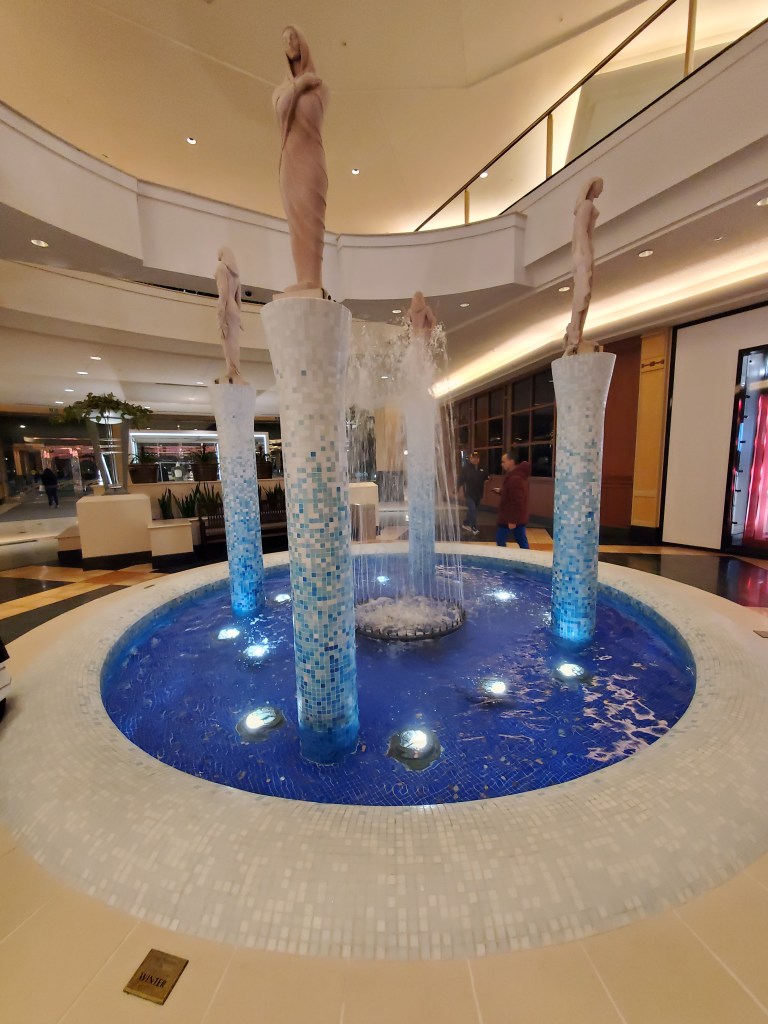
The mall I walk for exercise during Michigan’s shitty winters is bougie, as the kids like to say. They’re not wrong. These sculptures are 98 years old.
As we get older, we realize the universal truth that thrilling sensory explosions are rare or gone altogether. Little is new any more, at least in a good way. For a Gen Xer like me, so much of my mall experiences were associated with fresh feelings and sensations. Those have largely been dulled with time. When was the last time any of us over 30 or 40 experienced something so profoundly Technicolor rapturous that are heads spin and heart race with the shock of the new? Growing up, every week or even every day could hold such an experience.
Mall life was universal for a lot of suburban Boomers, Gen Xers especially, and older Millennials. And like those age cohorts, the shopping malls of our childhoods are graying. Or worse.
How did we get here? First, a quick primer on the birth, life, and death of mall.
The DNA of the enclosed shopping mall can be traced to 18th century Europe, but didn’t really take the form we know today until the post-war boom of the mid-1950s. Then America built a shitload of malls because we fucking love to buy shit and what better way to exploit that retail lust than to cram all of the stores together, out of the weather and definitely out of those scary downtowns we let fall into neglect? Shopping malls, baby. They became the new downtown, the new town square, the new park. Which meant a lot of actual downtowns in little cities, towns, and villages withered.
By the 1980s, there were about 2,500 shopping malls across the country. But as preferences and technology evolved, it couldn’t last. The number of U.S. malls has since shrunk to around 700, and that total is expected to keep dwindling. The other day, Macy’s announced it would close 150 stores, including 66 in 2025. Two of those are near me: at Oakland Mall and at all-but-dead Lakeside Mall in Sterling Heights.
The loss of anchor stores is enormously damaging, and often fatal, to malls. We’ve all been to such malls where Sears or some other anchor is closed, and the rest of the mall is clearly in rapid decline. It seems like every Rust Belt city and Midwest suburb has experienced shopping mall death.
By now, the concept of the dead mall is nothing new. It’s a morbid fascination for the generations that experienced enclosed shopping malls as the literal shared communal architecture of our youth. Dying or shuttered malls dot the nation. Plenty of YouTube videos provide eerie and melancholy homages to abandoned malls. They are prime examples of liminal spaces. It’s such a phenomenon that even Steely Dan sang apocalyptically about The Last Mall. And that song came out 22 years ago:
Attention all shoppers
It’s cancellation day
Yes the big adios
Is just a few hours away
It’s last call
To do your shopping
At the last mall
A couple of dead malls still haunt my dreams.
One is Tri-County Mall in suburban Cincinnati, where I spent junior high and my first three years of high school. We moved to quickly gentrifying West Chester in 1985, and Tri-County was the nearest mall, less than 15 minutes away. It was a single-story mall, with a second story and fourth box store (McAlpin’s) added at the start of the Nineties — a very cool project because the lower level stores had their fronts enclosed like outdoor stores with doors and windows, and name signs hung perpendicular outside the shops. It was like walking an old-timey street but inside.
It went from a dark stone and concrete mall to one that was bright and airy, skylights above, and with white walls and light floor tile. We’d left for Florida in 1991 for my senior year, but I returned to Dayton for college and my first professional newspaper job a couple years later, so I got to experience the refreshed Tri-County Mall as a young adult. It was a memorable change to have witnessed and experienced. I once bought a cassette single of Blondie’s “The Tide Is High” there — the sort of thing you tell a Gen Alpha kid and they then earnestly ask you if you lived during the Civil War.
By the mid-nineties, life and my career had carried me elsewhere and I rarely returned. The last time, many years after my last visit, was in 2018 and Tri-County was in its death spiral. The only thing that remained from when I was a teenager was a Suncoast Motion Picture Company video store (which was a surprise) and a Gold Star chili place (which was an even nicer, tastier surprise) in the food court. Long closed were Arby’s and Pizza Hut, and all the other stores I enjoyed. At the height of the Junk Wax trading card era, that mall had three card shops. Also, a model/hobby shop that I loved along with B. Dalton, Waldenbooks, Brentano’s bookstores. All gone now. Just fuzzy memories. There are barely any vintage photos of the interior online, which is a shame but not a surprise since my time there predated digital cameras by a generation.
Tri-County Mall itself is now a memory, too. It’s officially a dead mall. It closed for good in 2022 after 62 years in business. The latest plan to replace it is the oft-repeated idea to repurpose old malls: A billion-dollar mixed-use project with apartments, hotels, office space, and a more modest spread of retail and entertainment options. I hope it works.
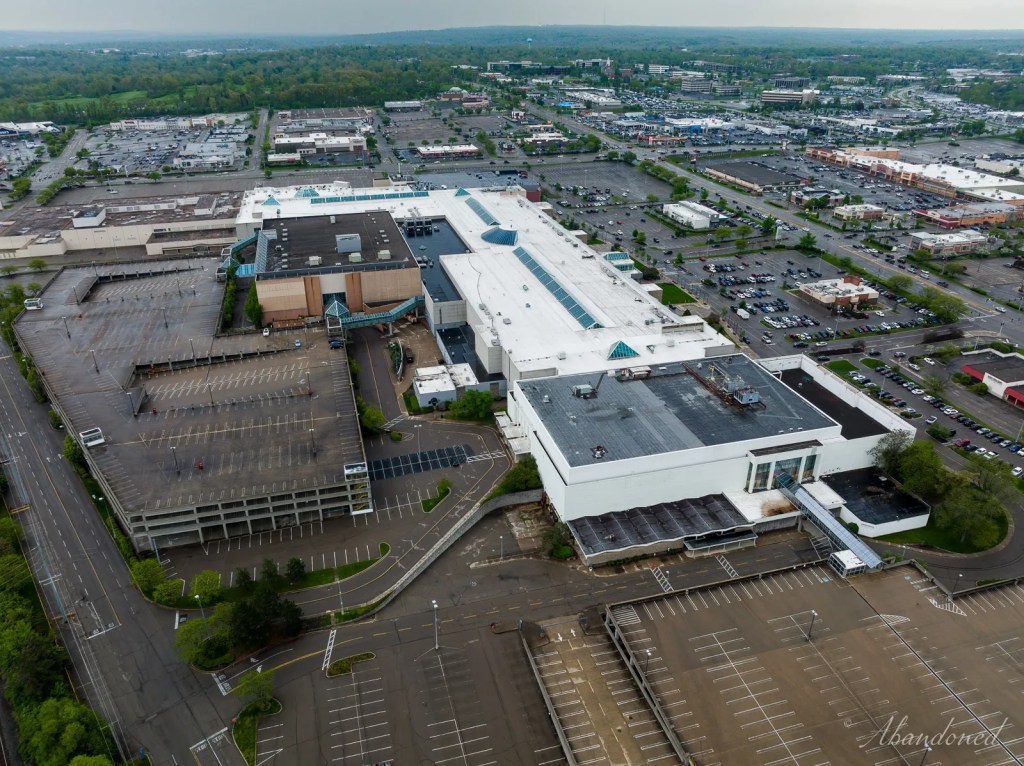
Aerial view of now-dead Tri-County Mall. (source)
While Tri-County was expanding in its heyday, just a few miles away an absolutely batshit competitor arrived on the scene: Forest Fair Mall, which was billed as the nation’s second largest indoor mall when it opened.
Only it never fully opened. It was one of the greatest mall boondoggles in history.
The doors opened in summer 1988, just as I was about to start high school. The new mall was enormous and gorgeous and wonderfully weird. Part of it was a single story wing anchored by a Bigg’s (a sort of Target), and the other wings were two-story (I believe the mall was built on a hillside). But only a handful of the storefronts were actually open, with more coming the next year. I remember one wing always being dark because nothing was in it, despite the rest of the mall being busy — something that probably stemmed from one big box store pulling out of the project at the last minute.
Forest Fair eventually had five anchor department stores, a colorful and funky aesthetic, a memorable entertainment area and food court that included mini golf, a Ferris wheel, carousel, and movie theater. There was a Wallaby Bob’s brew pub that I have no memory of. The limited memories I do have of this place are fading. Still, I do recall it being busy at times, especially with kids and teens. No one had their face in phone screens because such devices didn’t yet exist. Which also meant we were free and on our own when are parents dropped us off at the mall – no electronic leash. A bit of a lost Eden.
We didn’t shop much at Forest Fair because Tri-County was closer, and there were other malls nearby that had more stores. It was insane that Forest Fair was even built, not just because it was sandwiched between two nearby malls and retail areas, but also because it was built as a kinda, sorta, maybe upscale retail mall in a very working class area. It was always out of place and could never decide what it wanted or needed to be, but it was all in vain regardless because there simply was no room in an over-saturated mall market.
Honestly, it was sort of amazing it lasted as long as it did because it was never going to work. The comically over-leveraged owner filed for bankruptcy soon after the mall opened. It traded hands several more times, with each new owner trying some ideas to make it work. None really did. It wasn’t online shopping that killed Forest Fair. It was big dumb ego.
I went back only a few times when it was still an active mall, and at one point they tried to make it an adult party spot to booze after work, if I remember correctly. The complex had several names over the decades, but I know it only as Forest Fair Mall.
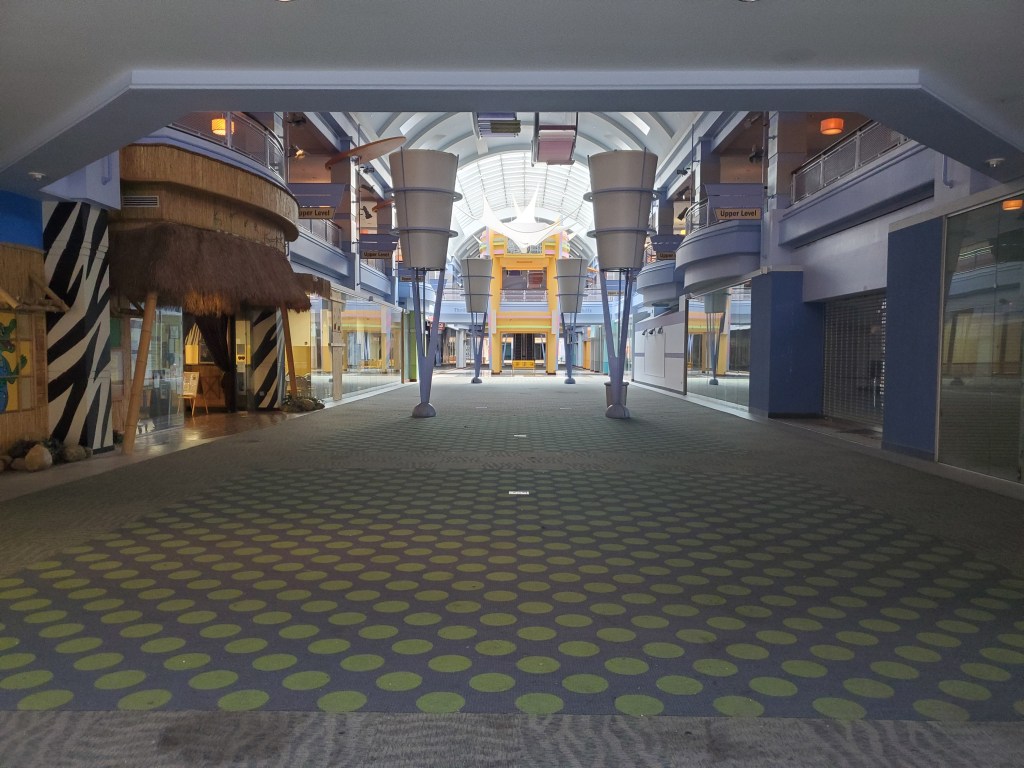
My last visit was in August 2022, and the photo atop this essay was taken then. It was a bit emotional, a surreal bummer. The place was nearly abandoned, with a few exterior-facing big-box stores like Kohl’s and Bass Pro Shop, but the dimly-lit interior was nearly entirely shuttered – it looked like a garish Technicolor fantasy dream frozen in time. One men’s room had most of the mirrors smashed and glass shards strewn about, but much of the mall was actually in decent shape despite the neglect. The food court was entirely closed.
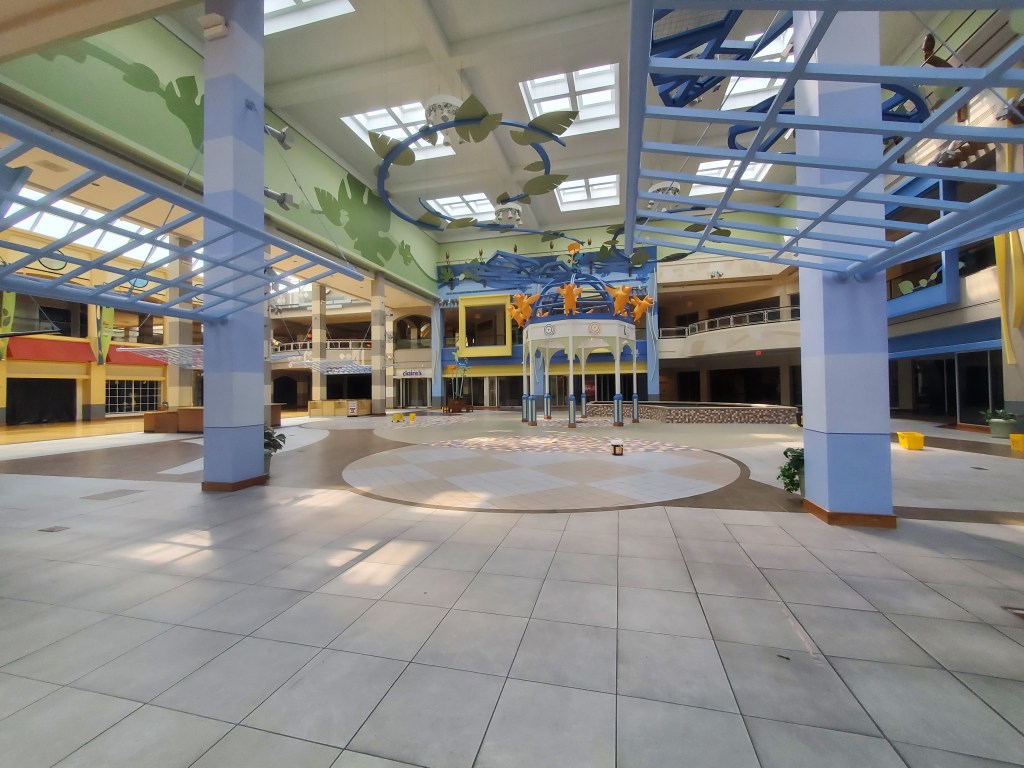
What I could see of the last serious remodel attempt from years before seemed okay but ultimately doomed. In just a few spots, I recognized sparse remaining original elements, like floor tile in one far-flung entrance. It reminded me slightly of the dusty abandoned Las Vegas casino where Harrison Ford’s Rick Deckard hides out in Blade Runner 2049, i.e. a lonely, sad, abandoned space with nearly zero human activity but had once been a colorful, loud, thriving, pulsing vortex of humanity. It’s a place that could have been easily salvaged if there only was a reason to salvage it. There is not.
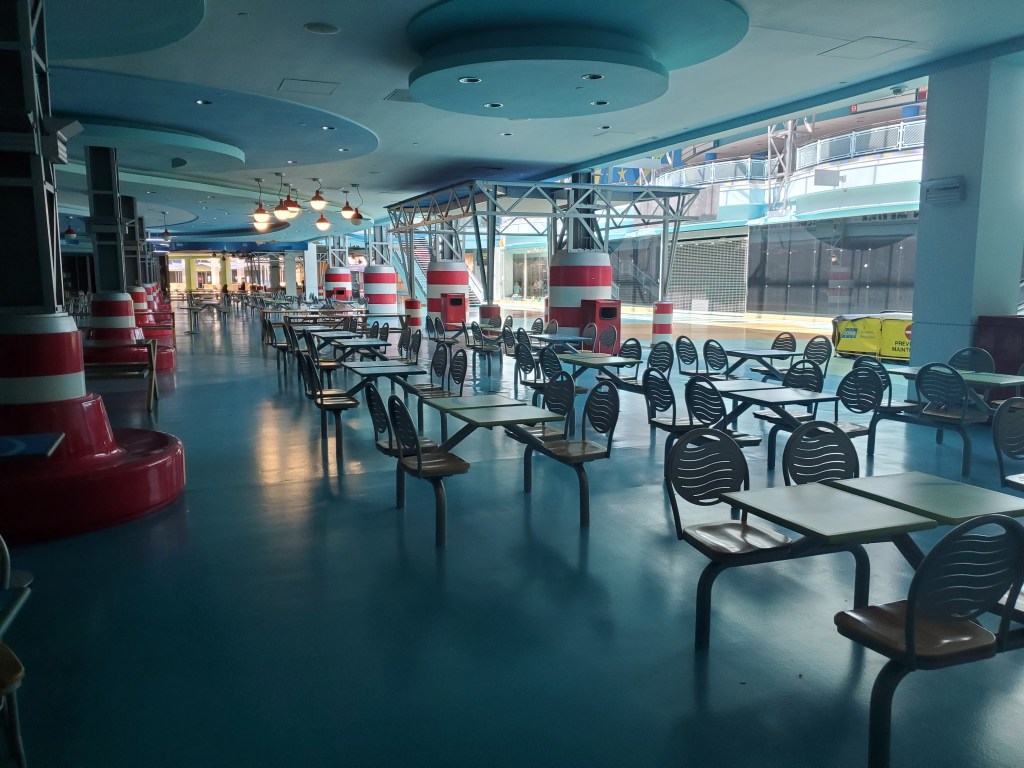
The day we visited, security guards were being creep assholes about taking photos because what else are dead-mall Paul Blarts going to do but hassle the rubberneckers checking out the corpse?
The interior of the mall was finally shut down a few months after my last visit, and the Bass Pro Shop then moved to another a few miles away. Kohl’s plans to close this April. The the mall will be be razed. Another memory demolished.
RIP, Forest Fair, you big stupid useless, unnecessary and loveably unloved mall. I hope the townie security guards find nice jobs cutting lawns.
The mall I grew up with while in elementary school in suburban Pittsburgh was called South Hills Village. It’s still around and looks to be doing well. It was built in a busy area off Route 19, and lots of retail grew up around it, including a huge new toy store on the mall property when I was in fifth grade. It was a major rush to walk in and see entire aisles of every available G.I. Joe, Star Wars, and Transformer toy in 1984, stacked higher than I could reach.
The mall itself has undergone several facelifts. South Hills Village opened in 1965 and had been renovated at least once before I arrived there in 1981. Gone by then were a huge bird cage and two-story rain waterfall.
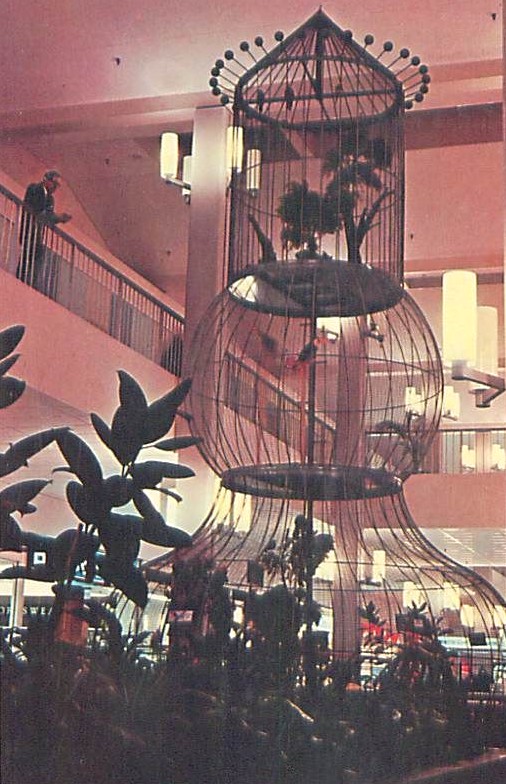
The 28-foot bird cage, with birds from all over the world, was gone from South Hills Village mall by the time we moved nearby in 1981. (Source)
South Hills Village was the northern terminus of one end of my childhood world, the other being the Donaldson’s Crossroads shopping center (a long strip mall, really) to the south on Route 19 that included a Crest movie theater, Mellon Bank, Giant Eagle grocery store, a long-since-defunct five-and-dime Murphy’s Mart that I adored, and a video store. Oh, and a malicious orthodontist. While we occasionally went into downtown (“dahntahn” in Yinzer) or the opposite direction south to Washington Mall after half-hour’s drive. I saw “E.T.” there in 1982. That mall is dead.
Today, long gone from South Hills Village mall are the Woolworth’s, Kaufmann’s and Gimbels department stores that I remember. My late sister worked at a hair salon in the mall, and for a time my brother worked at the Radio Shack. All gone now. The AAA travel center inside the mall provided us with paper flipbook TripTiks for vacations to Myrtle Beach, a sort of analog Google maps-Wikipedia combo in the early Eighties. There was a Stouffer’s restaurant inside the mall we’d eat at on special occasions — was it upscale? No idea. I was a kid. I was more concerned about Optimus Prime and Megatron and “The A Team.” I do recall that malls and their anchor stores always had diners, cafes, or full sit-down restaurants, not just food court stuff. And back then, people smoked inside. I do not miss that. I do miss the eateries, like Ernie’s Delicatessen and Elby’s (a Big Boy brand). I spent a lot of time with my mom and sometimes my siblings in those food joints. My dad didn’t come to malls very much.
These days, I live just a few miles from Oakland Mall in Troy, Mich. It opened in 1969 with a performance by a rising local musician named Bob Seger. I became a heavy Oakland Mall visitor after I moved to downtown Detroit in 2008, even getting my hair cut regularly there at the old-school barbershop near the pet store that’s also somehow an off-brand Build-a-Bear. Four years later, I moved even closer. The mall was showing its age.
Today, Oakland Mall is gliding toward an inevitable fate. Sears is gone, and Macy’s is about to follow. JCPenney is hanging on. Many but not all of the chain stores are gone, replaced with local independent shops that tend not to last long. The current mall owner has lured a handful of Asian-themed pop culture businesses, but I’ve never seen them busy. That said, I was there on a recent Sunday and there were lots of people walking around. It’s a working class mall these days. It still feels like the mall’s in its twilight, which is strange because it wasn’t all that long ago it was thriving.
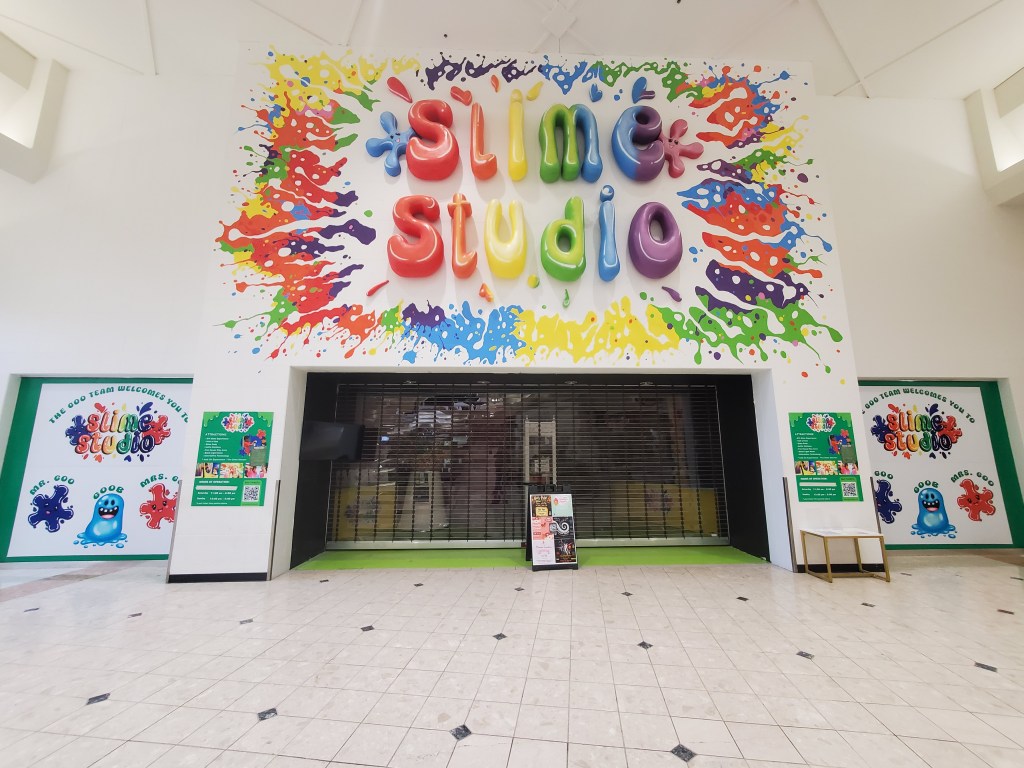
This is the former Oakland Mall entrance to Sears. The space has been a number of things like this, while the rest of Sears became a Hobby Lobby and an At Home. Neither are accessible from the mall.
A Dick’s Sporting Goods added to the mall a few years ago has an exterior entrance, so it can survive after the mall shutters. Sears was replaced by a Hobby Lobby and an At Home, which are connected to the mall but do not have entrances into the mall itself. I am sure that’s by design. They’ll endure after the mall has met the wrecking ball.
An old-school pinball machine and stand-up video game arcade recently arrived at the mall (taking the space of the original arcade). Some of its wall decoration referenced it being 1990 again, which obviously appeals to me, but it doesn’t feel like an arcade in 2025 is going to be a huge hit that saves the mall. I hope I’m wrong.
Oakland Mall saw its Things Remembered close, and that’s never a good sign. Losing that place always felt like the canary getting sick inside the coal mine.
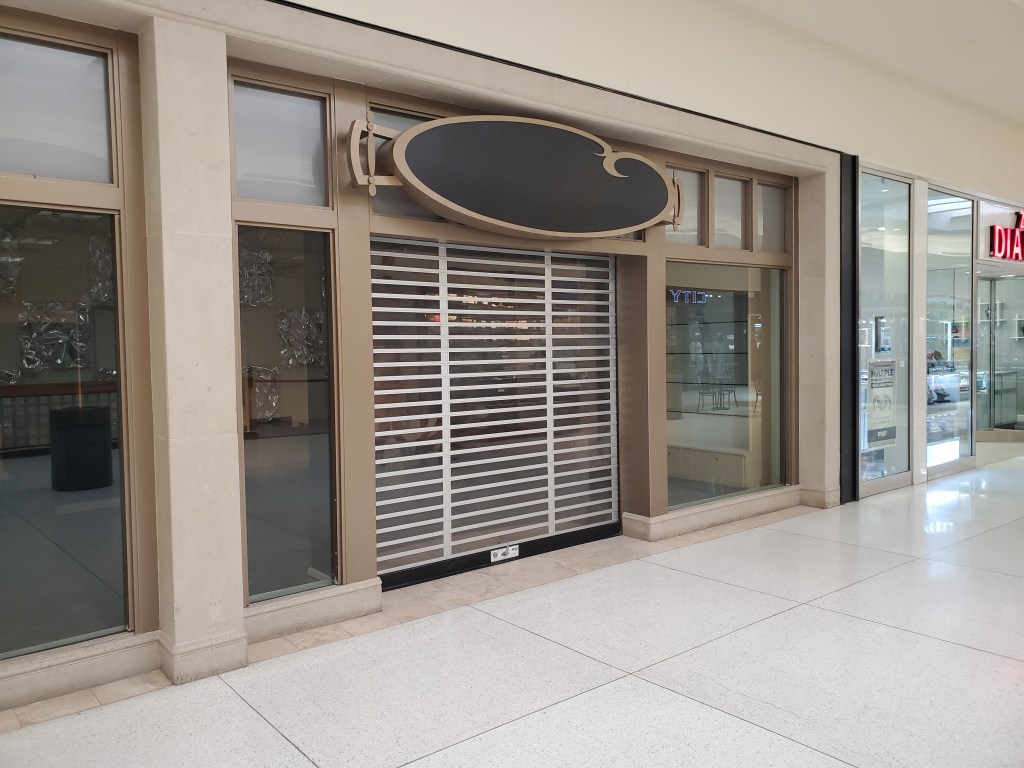
A forgotten Things Remembered at Oakland Mall.
The area surrounding the mall is still densely populated and retail appears to be doing okay because the stores are what people want. They just no longer want much of what’s inside Oakland Mall, and with less money coming in, the mall itself is looking a bit disheveled. The clock is ticking on it.
A few miles up I-75 is my current regular mall, which I refer to as the “rich mall” — The Somerset Collection, which spans both sides of the gloriously named Big Beaver Road (Exit 69) via a 700-foot glass and steel enclosed pedestrian bridge with airport-style moving walkways.
While just a few miles from Oakland Mall, Somerset feels like a different retail universe. It’s a contrast in American socioeconomics. It’s where I buy my boxer-briefs at America Eagle. Can’t afford too much else there.
The larger half of Somerset on the north side of Big Beaver is three stories, anchored by Macy’s and Nordstrom. The retail stores are almost all well-known chain shops. The lower center court has enormous marble balls that spin on water, the elevators are based in a large fountain, and the central space is where they put up an enormous castle for Santa at Christmastime. The food court includes a new Potbelly location and two spaces were taken up by a recent Shake Shake location. It also is home to a Bigot Bird, aka Chick-fil-As. It’s closed on Sunday, of course, because of the religious zealot owners.
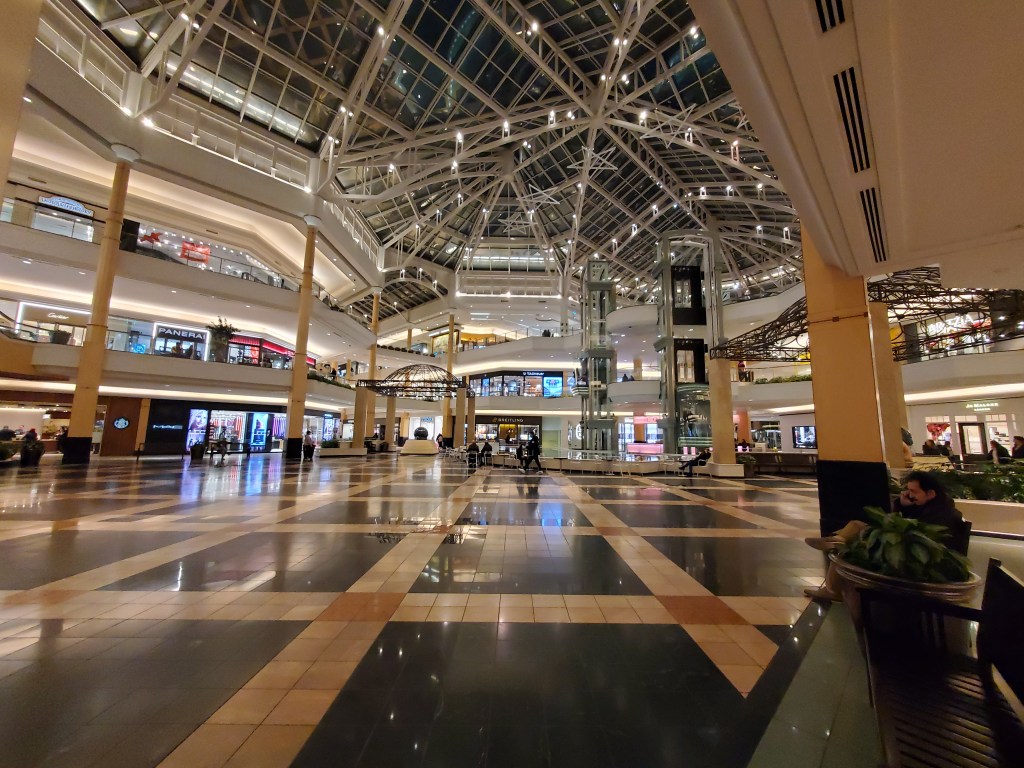
The Somerset Collection in Troy, Mich., is one of the nation’s most upscale malls. This is the central plaza of the triple-story north side of the mall. A 700-foot skybridge over Big Beaver Road links it to a two-story wing. This place is fucking huge.
On the south side, which is the original mall and now two stories, are two anchors: Saks Fifth Avenue (built as a standalone store in 1967) and a Neiman Marcus. In between the anchors are the mall’s very upscale stores: Tiffany & Co., Ralph Lauren, Hermès, Louis Vuitton, Burberry, Gucci, Versace, Prada, Dior, Balenciaga, Moncler, and Salvatore Ferragamo (which, being a sports meathead in my soul, I always call Vince Ferragamo).
These are not commodity stores, so people will drive to visit them. Somerset is a super-regional mall in that sense and was built near affluent areas. You cannot order online a lot of what the wealthy want to buy, and the rest of us sometimes want to gawk at. Amazon-proofing is good business.
Somerset is well-maintained, with the only closed storefronts being those that are under expansion or being replaced by another chain. There are no mom-and-pop stores. There are no places selling fake jade chess sets and cheap samurai swords and Pocky sticks. It doesn’t even have a Hot Topic. It’s an adult mall. The security guards in the expensive wing wear business suits with microphones on their lapels, like knockoff Secret Service agents. The downscale anchor store is Macy’s — imagine telling that to someone fifty years ago.
It’s a racially and ethnically diverse mall, too, which is vital for any business to survive. I wouldn’t call it especially economically diverse.
Somerset will probably be the last mall to survive in Michigan. Rich people and the middle-class shop here, or they dispatch their underlings to “pick up their things.” The money is flowing. It’s where visiting celebrities and pro athletes are spotted. And walking the entire thing is about 2 miles, so it’s a solid place to get steps in when the Michigan weather is shit (which can be often).
Why so many shopping malls have declined and failed isn’t much of a mystery. Oversaturated markets. Changing consumer tastes. Local socioeconomic and transportation realities evolved. Online shopping exploded thanks to Amazon and other mass digital retailers. And to be frank, a lot of malls and a lot of stores were simply mismanaged. They bungled their general operations, or they couldn’t handle online competition. For some, it was both. Others did the best they could, but the battle was never going to be won. Circling over all of it were the private equity vultures, quick to swoop in with grandiose plans to revive a mall, only to squeeze out the last few pennies before killing it off — the plan all along.
The pandemic made things worse.
Some malls endure. Memories are still being made, but malls have receded from their dominant place in the culture. That’s a shame in some ways because where do kids gather outside of school? Online? That’s not much of a substitute for in-person antics and fun like we had with malls and shopping centers. It’s a fuddy-duddy thing to say, but I believe Xers have a unique POV on this because we’re old enough to have an analog youth and a digital adulthood. We played outside and in malls. We’re on our phones now as we walk the mall, too.
The malls themselves contributed to that social decay when they began enforcing curfews, dress codes, and other security measures on kids — and you know exactly what color kids these measures were mostly aimed at. It’s the story of America. Not all mall memories are positive.
I plan to travel in the next couple of years to see if I recognize anything at South Hills Village. My childhood home near there is mostly unchanged on Google Earth’s street view, but I’d like to find a sliver of my history at the mall. I’m a sucker for nostalgia and enjoy the archeological thrill of unearthing traces of a boyhood that’s receding by the day into a romanticized past.
As for the present, I’ve learned to understand and appreciate that these are the Good Old Days, too. I love walking Somerset. And it’s a helluva lot easier to preserve these memories thanks to the goddamn camera phone that’s never out of my hand. The next time I walk the mall, I’ll probably take more photos, like a weirdo. Maybe get hassled by better-dressed mall cops.
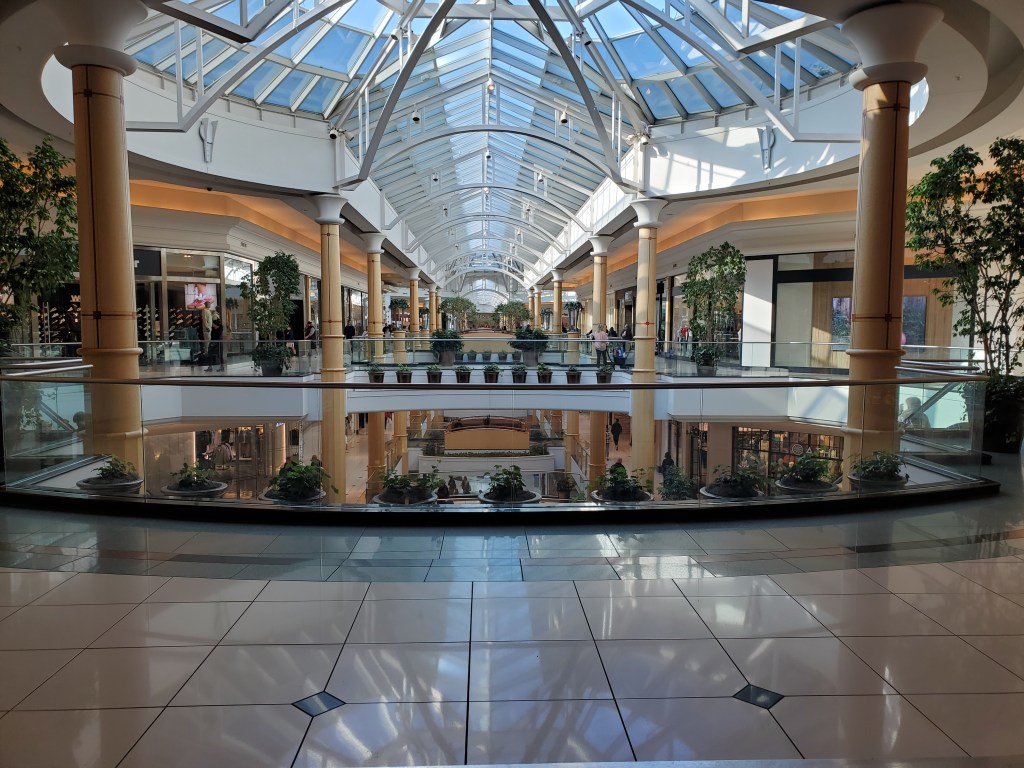
The Somerset Collection in 2025, taken from the third story Macy’s entrance. This probably will be Michigan’s last surviving mall.
I wish I’d taken more photos growing up. I’m still a mall kid at heart, even if the experience today is more about getting my steps in than playing Cyberball at the arcade or buying Vanilla Ice’s “To The Extreme” at Tape World. But I am happy I got to do those things.
-30-
 Unpaid Bills
Leave a comment