Not everything is bleak and dismal. Much is, but not everything.
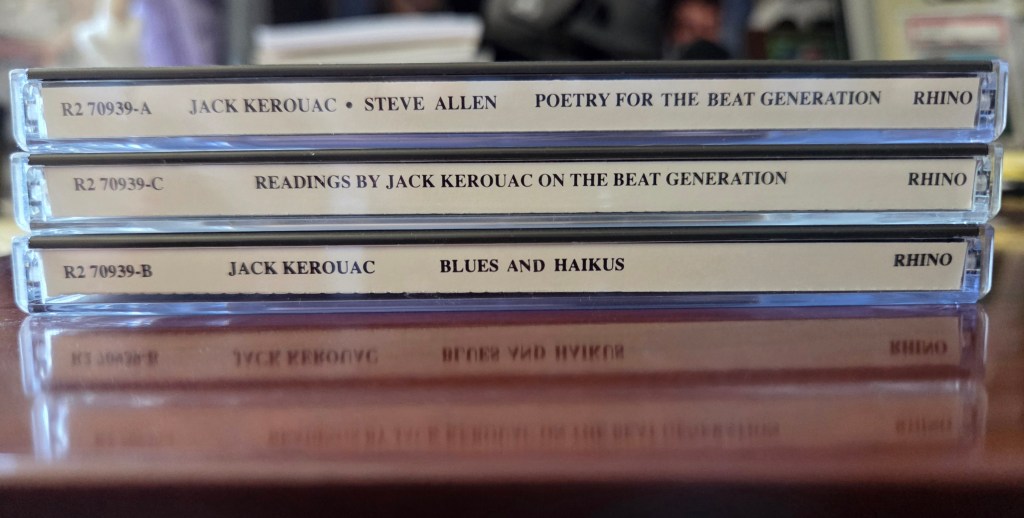
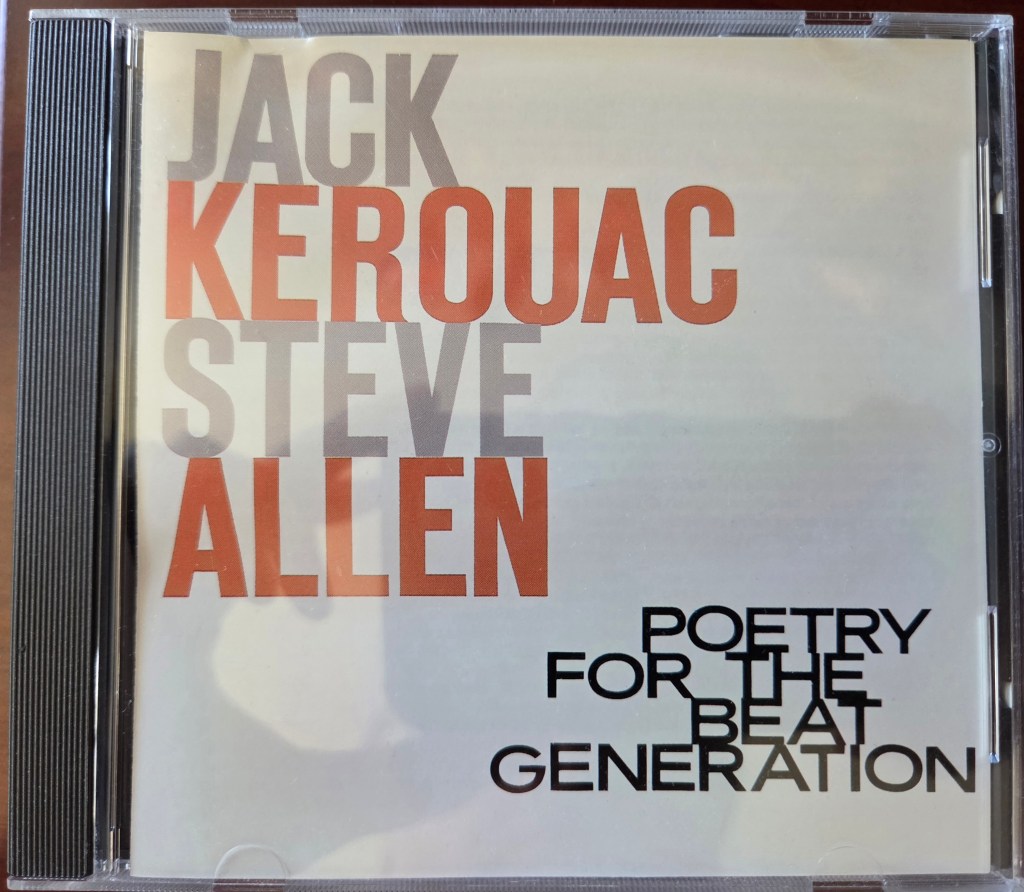
We’re in the waning days of October and that makes me think of Jack Kerouac and the Beats. I’m not entirely sure why but probably at least in part because that’s the month I repeatedly listen to his “October In the Railroad Earth” prose poem that he read aloud with Steven Allen on piano accompaniment for a 1959 recording. In the 1990s, when I discovered the Beats, it was part of a CD box set of Kerouac’s spoken-word recordings, and now I listen to it on streaming while driving or in the shower. Or while writing this.
“October” is literally in the title of the work, so I suppose my connection between the words and the calendar month isn’t much of a mystery. Same with why I think of Van Morrison’s 1970 hit “Moondance” as an October/autumn tune:
A fantabulous night to make romance
‘Neath the cover of October skies
Even if they didn’t mention October specifically, these works of art somehow capture the month perfectly. At least for me.
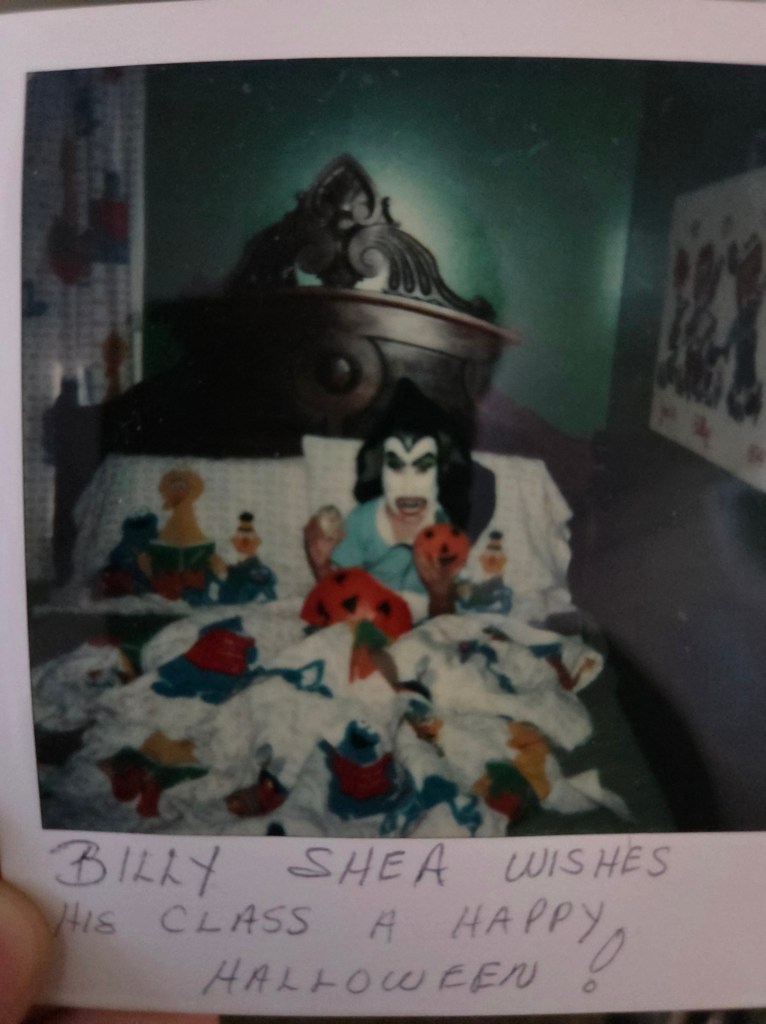
As a kid, I loved October for Halloween. My brain is filled with pleasant memories of costumes, pumpkin carving, trick-or-treating, and cartoonish decorations. Leaves turning color and falling alongside the temperatures. I was one of those late ‘70s kids with a coat over or under my plastic and vinyl Ben Cooper Spider-Man or Count Dracula costumes, trudging house to house in Midwest suburbia, hoping for chocolate bars and not something stupid like an apple or popcorn ball or a dime. Or the dreadful Smarties.
I was sick with bronchitis at Halloween 1979 and missed the school festivities. My mother took this Polaroid of me in bed and took it to school.
October is also a month for football, from my own chilly Friday night schoolboy prep dreams of one day side-arm passing the Cleveland Browns to the Super Bowl, to college and NFL games that dominated, and still dominate, weekend television in my house and millions of other homes every October.
As an adult, October remains a favorite month. Not so much because of Halloween or football that became its own horror franchise for me. I have little interest in scary movies, gore, jump scares, etc. No, I enjoy the month because it’s the bridge between summer and winter. You get sunshine and darkness, warmth that surrenders to the cold. You see a radical change in nature and the environment. It’s powerful and bucolic. I cling to such things, and reveries, while the world falls apart.
The day after Halloween begins the Christmas season for me, but I enjoy October while it lasts.
Hence, Kerouac’s voice is my soundtrack for the month.
His was a memorable voice, perfectly aligned with his material and the image you probably have of handsome younger Kerouac rather than the disheveled sloppy drunk that moved to Florida to live with his mother and vote for Barry Goldwater in 1964 and then die of an esophageal hemorrhage and cirrhosis five years later at age 47.
He died in October five years before I was born. I could have lived at the same time as Jack Kerouac. Weird.
Whatever it is about Kerouac and the Beats, they’re an October phenomenon for me while everyone else is getting into Halloween. My head is full of Kerouac’s voice, which is a unique blend of a mid-20th century Lowell, Mass., which was his working class mill town birthplace, and the Quebecois dialect called joual that he spoke natively as a young child in Lowell’s French-Canadian quarter. It’s somehow a perfect voice for his poetry and prose.
The imagery evoked by that voice reading “October In the Railroad Earth” is a cool sunny October day in San Francisco – the literal geography of the poem – and I think of leaves turning color and drifting to the sidewalk and grass. People are in their 1950s trench coats and hats in the autumn air, not quite cold but certainly brisk as summer has given way to a classic autumn.
October has a certain tragic romance to it, too.
As the sunlight fades into the gloaming and night begins to fall, I think of myself driving along suburban Royal Oak’s east-west mile streets last October. The streetlights glow yellow in still-leafy hollows of oak trees that are now full of color, the old sodium lights burning their soft glow amid the red and orange foliage (with some malingering green). I delight in that thought, my tires rolling along the smooth blacktop streets gently lit and Kerouac’s voice and Allen’s soft piano tinkling coming from the speakers to create my gently haunting autumn soundtrack.
That’s a comforting scene to me, but also one born of angst and hopelessness and fury and profound sadness of unfolding personal and impersonal tragedies (mostly) beyond my control. The sights and sounds and sensations of that late evening October drive kept me, and still keep me, from going mad. So do the chemicals from my doctor and my dispensary.
I’ve never understood better what they meant by the Beat Generation. Even joy drains you. You have to be beatific to not righteously lose your shit these days.
What about Kerouac’s words? I don’t think they work with any other voice. His perfect random gibberish, the “bop prosody” aka Spontaneous Poetics with cool jazz pumping through its veins somehow makes sense to me seventy years later. Maybe I’m not smart enough to understand it, or maybe it’s all bullshit, but I enjoy it. I didn’t enjoy “On the Road” as much as I did his other works such as “The Dharma Bums” “Big Sur” and Vanity of Duluoz” and his poetry.
October also is my Chet Baker month. A contemporary of Kerouac and the Beats, the jazz trumpeter and singer put out an instrumental album in 1959 simply called “Chet” that he recorded with icons like Bill Evans, Herbie Mann, and Detroit’s own Kenny Burrell. I’m not at all a jazz aficionado but I enjoy this album immensely and even have a copy framed on a wall. That’s model Wally Coover on his shoulder.
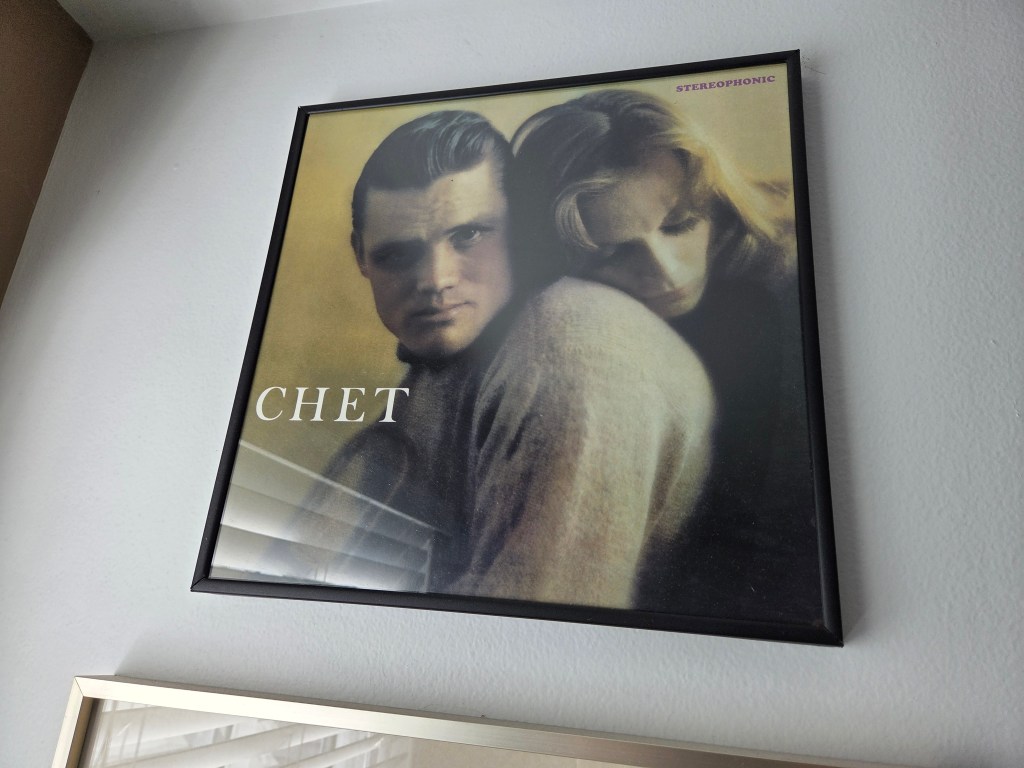
Baker was already a heroin addict by the time this album hit shelves, and it was an addiction that would plague him and his career for the rest of his life, and eventually kill him in 1988 when he fell out of a window in Amsterdam.
The standards that Baker plays on “Chet” are languid, melodic, calming. They’re perfect. “Tis Autumn” and “Alone Together” make me want to sit back deeply on a wool couch, the late October afternoon sunlight diffused thought brown curtains and spilling yellow-orange onto the rug while I sip Johnny Walker Blue, lazily flipping through a copy of The Saturday Evening Post or The Nation while a Chesterfield cigarette languidly burns in a black Stork Club ceramic ashtray on the end table in a family room paneled with knotty pine. It’s a “Mad Men” scene I suppose, even though I wasn’t into that show or era. Perhaps there’s a Mid-Century Modern alcove in my brain where every day is cool, slow jazz 1959 despite me not being born for another 15 years. Weird. But in my defense, a lot of late 1970s family rooms I grew up in or visited still looked like 1959.
Speaking of the Beats, these are the latest books on my nightstand TBD pile, in random order:
A Remarkable Collection of Angels: This is Beatdom editor David Wills’ new book about the poetry reading – most notably, Allen Ginsberg’s first public reading of his still-unfinished “Howl” – on Oct. 7, 1955, at the 6 Gallery on San Francisco’s Fillmore Street. There’s never been a serious book-length treatment of this critical moment in the rise of the Beat Generation, until now. Also reading that day 70 years ago were Michael McClure, Gary Snyder, Philip Whalen, Philip Lamantia, while Kerouac was in the audience (blitzed) along with Neil Cassidy and Lawrence Ferlinghetti. It was Ferlinghetti, the poet owner of City Lights Pocket Bookshop, who would immediately telegram Ginsberg asking him for the rights to publish “Howl” with the famous line, “I greet you at the beginning of a great career.” The poet and essayist Kenneth Rexroth was the master of ceremonies for reading, which was attended by about a hundred people and is considered perhaps the seminal event that launched the Beat Generation from within the counterculture/avant garde San Francisco Renaissance that had begun gestating in the 1940s.
Wills, who I’ve known for a while on social media, also has written books about William S. Burroughs, Allen Ginsberg, and Hunter S. Thompson. He knows his stuff.
Kaplan’s Plot: This is the highly-acclaimed debut novel from one of my favorite magazine writers, Jason Diamond, whom I occasionally trade memes and observations with on Instagram (he’s hilarious and righteous in his posts, FYI). I’ve yet to dig into this one because I am saving it for cold(er) winter nights around the holidays, to digest between leftovers and third-tier college football bowl games that for some reason kick off at 11 a.m. on a Wednesday. Anyways, here is how Forward describes the book: “… a terrific debut novel that toggles between a grandson digging through family graves and the mobster rise of his Odessa-born grandfather, Yitz, on Maxwell Street.
“The book moves between present-day Chicago and the turn of the last century. In the present, Elijah, a young man in the tech startup world who believes in little beyond money, cares for his mother, Eve, a poet dying of cancer. He stumbles into family secrets that threaten his shiny life and force him to decide what kind of man he is. In the past, two brothers arrive from Odessa, learning that survival is a craft — one behind a butcher’s counter with shining knives, the other in a city that runs on favors and implied threats. Real people inspired the story, but Diamond wanted fiction’s latitude to bend fact toward a truer arc, and that inventiveness is what I liked most. The book, by turns comic and sharp, bends history toward story until it feels both familiar and strange.”
Sounds enticing, no?
Always Crashing In the Same Car: This memoir of L.A. essays/snapshots feels like Matthew Specktor wrote it directly for me. F. Scott Fitzgerald, Thomas McGuane, and Warren Zevon? The dark underbelly of chasing success in sunshine-drowned Los Angeles? Divorce? Failure? Booze and drugs? Not cracking up? Chateau Marmont? Fucking yes, please, thank you. Specktor is a few years older than me and grew up the son of entertainment industry people and it feels like we led similar lives and experienced some of the same lows. I’ve not been moved by a book, especially non-fiction, like this for a long time. It’s a history of himself, his family, the city, and Hollywood, told through his fascination with a handful of notable people. These are fascinating snapshots of people that made it, but also sorta never get beyond the outer-inner ring of success and celebrity during their lives (or lost it).
Specktor, a founding editor of the Los Angeles Review of Books, is a fine storyteller and even better slinger of prose. His sentences fuel me with the good kind of envy.
In the spirit of failed alcoholic screenwriters genre, I’ve also picked up Fitzgerald’s “The Pat Hobby Stories” and the 1991 novel “Force Majeure” by Bruce Wagner.
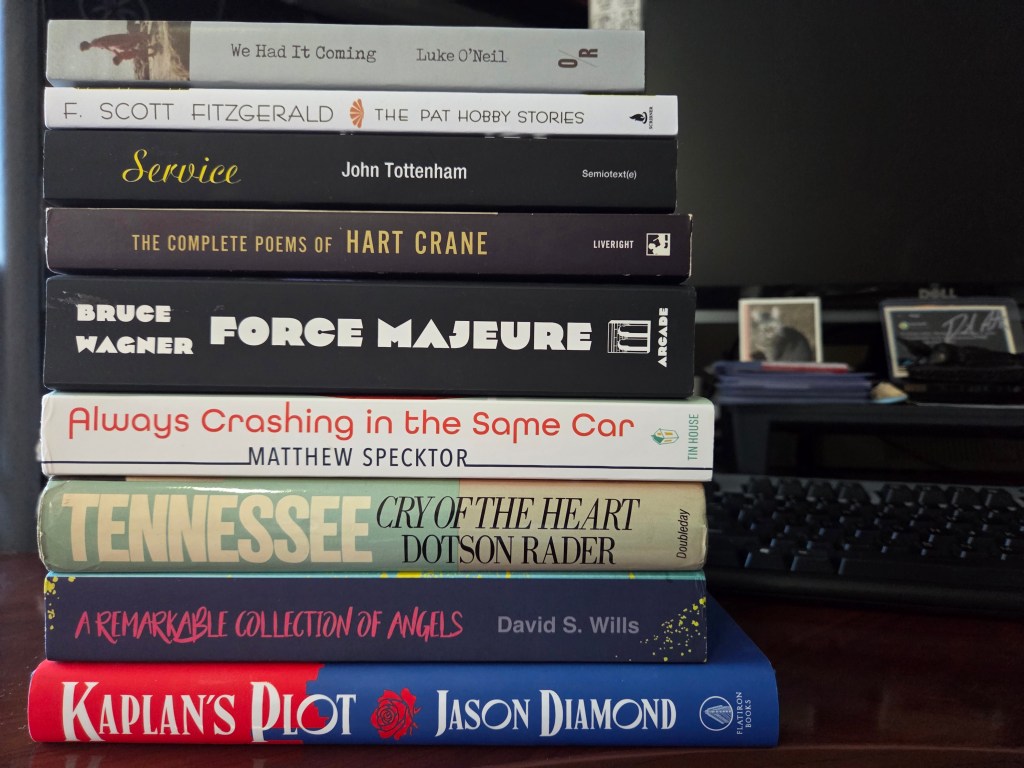
Service: The premise of John Tottenham’s hilarious new novel is a jaded middle-aged man, having lost his journalism career due to the newspaper industry’s self-immolation, now works in an L.A. bookstore and struggles to write his debut novel in a world of younger sell-outs and relentless gentrification. Insecurity, indignities, bitchiness, and blank pages? This basically could be my autobiography, except for the Los Angeles part. Shades of Ignatius J. Reilly? I feel that in me, too, as I get late into the third quarter of my life.
We Had It Coming: I’ve been a fan of Luke O’Neil’s “Hell Word” writing for many years, and he’s the righteously angry and witty author of this new volume of fiction and poetry that’s written in his usual unique stream-of-consciousness style. If you live in end-stage capitalism 2025 and everything you see and experience makes you want to scream and pull your hair out, O’Neil is for you. He doesn’t leave you hopeless, but you recognize the rage and despair at the vulgar, cruel stupidity of it all from the micro to the macro level. He also makes you laugh, and I’m not sure anything is more important today that being able to laugh despite … well, everything. If this book isn’t required reading in college classes a century from now, then we’ve truly fucked up.
Two superlatives from people I admire sum up this book:
“His stories make me feel less insane. – David Roth
“Luke O’Neil is the poet of our shared doom.” – Maria Bustillos
Also on my new or newish nightstand, collecting dust as I doomscroll Bluesky:
- “The Complete Poems of Hart Crane” by, obviously, Hart Crane
- “Tennessee Williams: Cry of the Heart” by Dotson Rader
- “The Collected Poems” by Slyvia Plath
- “First as Tragedy, Then As Farce” by Slavoj Žižek
And since Friday is Halloween, here’s my list of favorite horror films. I’ve grown much less interested in scary movies as I’ve gotten older because life itself holds enough frightening shit in store. And I especially do not care for cheap jump scares and body gore. But I have my favs.
Exorcist III: A magnificent sequel to the original. This is thinking person’s horror, and comes from William Peter Blatty (who wrote the original “Exocist” novel and screenplay, and this sequel as “Legion” before directing the film). The terror is real, but there also is excellent dry humor. George C. Scott is perfect in this film. I think it’s one of the most underrated horror films of all time. It’s so well done. Also, cameos by Patrick Ewing and Fabio!
Shadow of the Vampire: A dark comedy satire of the original filming of F.W. Murnau’s “Nosferatu” with John Malkovich as Murnau and Willem Defoe as the vampire, who is starring in the movie-within-a-movie. Also, (Suzy) Eddie Izzard! Cary Elwes! Clever movie with some hilarious moments, and also horror.
Dracula (1979): Frank Langella as the count in this stylish and well done adaption of Bram Stoker’s epistolary novel. I have loved this one since I was a kid. To me, it’s the best mainstream retelling of Stoker’s story.
Dracula (2020): This is a three-parter that aired on the BBC and Netflix. It’s a great take on the story, and evolves it to take place in the last episode in modern times after the first two were at the historic time of the novel. And Van Helsing is a nun! The dialogue banter between Dracula and Sister Agatha Van Helsing is clever. This was well done, and I especially enjoyed the second episode that’s aboard the Demeter sailing to England.
Bram Stoker’s Dracula (1992): One you see this, and some of his earlier films like “One From the Heart” you can understand how Francis Ford Coppola came to make the gloriously batshit “Megalopolis.” Anyways, his 1992 Dracula flick is lush and expansive, but the best part is all of the actors just absolutely chewing the scenery, particular Gary Oldman as the count and Anthony Hopkins as Van Helsing. Winona Ryder and Keanu Reeves are so badly miscast in these roles that it somehow works. The story mixes Stoker’s novel with some of the historic Vlad the Impaler history.
Doctor Sleep: I am not sure you could have made a better sequel to “The Shining” that felt true to Stephen King’s novel and also the 1980 movie that he disliked. I love “The Shining” and find that this film successfully navigates the theme that King intended — the horrors of alcoholism — while still making sense as a sequel to the iconic original. I also like that the bad guys in this one are not wildly all-powerful. They sustain some ass-beatings long before the climax. I think more horror stories and movies should even out the odds between good and evil, since that’s how real life works. Much of Hollywood horror is feeble protagonists eventually overcoming cartoonishly powerful evil villains. Make it closer odds. That feels real and more interesting and fresh. And in the age we live in, I want to see baddies just sorta get worked over from the start, ya know? Punch zombies, punch vampires, punch Nazis.
[Editor’s note: I intended to publish this last week but upon completion of it developed what the emergency eye center’s doctors tell me was a retinal migraine that was painless but scared the shit out of me. So this essay is a few days late, and I am fine. I hope.]
-30-
 Unpaid Bills
Leave a comment