Sometime in the Greed-is-Good neon plastic Reagan mid-1980s, we visited my older brother and his family deep in the desperate wilds of southeast Ohio, not far from the river and amid crushing rural poverty.
As younger siblings often do, I looked up to my brother, who was tall and lean and a dozen years older than me. He was itinerant in those days, and I always was interested in the handful of ever-changing books on his shelves. One in particular caught my eye: the trade paperback biography of Jim Morrison called “No One Here Gets Out Alive” – a title taken from a Doors song lyric and used by authors Jerry Hopkins and Danny Sugarman for the book’s 1980 publication.
While later somewhat discredited as an exaggerated cartoonish portrait that lacked nuance, the book at the time was the definitive profile of The Doors’ enigmatic and erotic lead singer-poet who perished, probably from heroin but maybe not, in a Paris apartment bathtub in 1971 – making him a charter member of the infamous 27 Club.
What initially drew my youthful curiosity to my brother’s dog-eared paperback was its vivid cover, a version of photographer Joel Brodsky’s iconic 1967 “Young Lion” image of a bare-chested Morrison wearing a thin glass-beaded necklace while drunkenly mugging for the camera. The cropped cover photo was printed in bold tones of yellow and red, and it caught my attention amid my brother’s stack of bland old college textbooks and otherwise unremarkable novels.
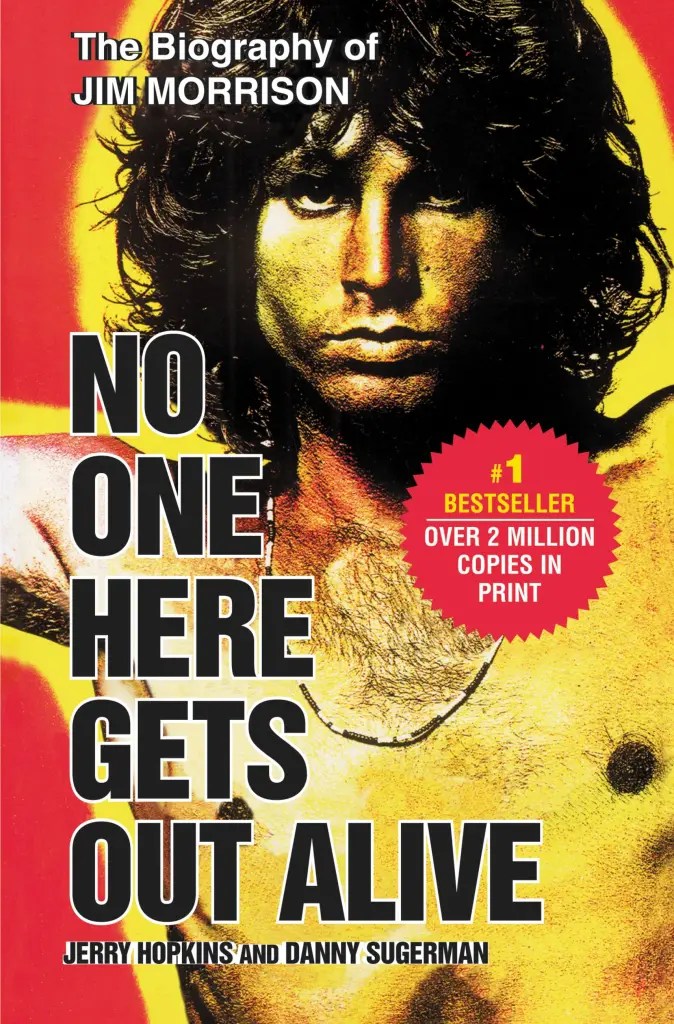
While I cannot recall my thoughts upon first seeing that book, they certainly must have been along the lines of a simple, “What’s this about? Who is this wild man with long hair and intense facial expression?” I’m not sure I’d heard of The Doors at that point. I probably had heard some of their radio hits or my brother’s albums roaring from his bedroom before he went off to college. The book cover intrigued me, and I think my brother made it seem like a forbidden text because of who and what it was about. What’s that going to do but pour gasoline on an adolescent’s desire to experience something outlawed by grownups – especially a book?
So I took his copy. Or he relented and gave it to me. I was in that awkward era when a boy is somewhere between a child and a man, the weird and awkward DMZ between being a little kid and a moody, unlikeable teenager. My world at that point was still Star Wars, Transformers, and G.I. Joe, but the action figures were starting to make way for things such as girls, football, books, and music. Jim Morrison’s biography accelerated the process. It was the first step down a road I’m still on (and one now filled with orange construction barrels, potholes, circuitous detours, but still open).
I read the book with teenage eyes and a soft, unblemished mind keen to learn about the seedier side of adult life and exotic forbidden worlds. The word “transgressive” wasn’t yet in my vocabulary but the allure of it soon would be. This largely forgotten biography was an urtext for my life, and maybe it helps explain my past four decades. Perhaps it’s trite, and my apologies to Blake and Huxley, but the story of Jim Morrison and The Doors’ music threw open a door for me that allowed entry into a world very different from my sunny suburban Midwest shopping mall existence.
The story of Jim Morrison and The Doors – genuine sex, drugs, and rock and roll, with a lot of booze and ego and poetry and performative bullshit in the mix – is a familiar one by now, even if exaggerated in the decades since their brief time in the spotlight (just six studio albums from 1967-71). The drinking, the theatrics, the crowd psychology manipulation, the rhyme and verse bouncing between uneven and brilliant, and Morrison’s excess of public personality. The arrests and boorish behavior. Melodrama. Counterculture. The ethereal carnival music of the early albums, with Ray Manzarek’s haunting electric organ giving the lyrics their dark celebration-of-the-strange soundtrack. Songs about lizards and fire and ennui and angst and anger, rebellion and blood and myths and religion and death. Brooding and erotic. Failed love. The lonely road and the living desert. Dead Navajos. Nietzsche and Brecht. Rimbaud and the Beats. Dionysus and Apollo. Blake and Huxley. Byron and Dylan (both Thomas and Bob). Political mystics and sexual shamans. Céline. Media and spectacle. Artaud and McLuhan. Jazz and R&B. Psychedelic. Oedipal oblivion. East meets West. The Sunset Strip, the Whisky a Go Go, London Fog, Chateau Marmont, and to the east to the White Horse Tavern, then south to Miami and doom. Weimar Berlin acid rock meets Laurel Canyon blues.
Rock music didn’t sound or perform like that until The Doors, a band founded by a couple of well-read UCLA film school grads sitting on the sands of Venice Beach in July 1965.
That distinct Doors sound was there by 1966. It was new and profound amid the dance halls and airwaves still full of the Beatles and Monkees and L.A. surf tunes, and it’s still there today playing on oldies stations, still able to stir feelings when you get past the shopworn radio hits and you start to re-dig into the B-sides and the deep cuts.
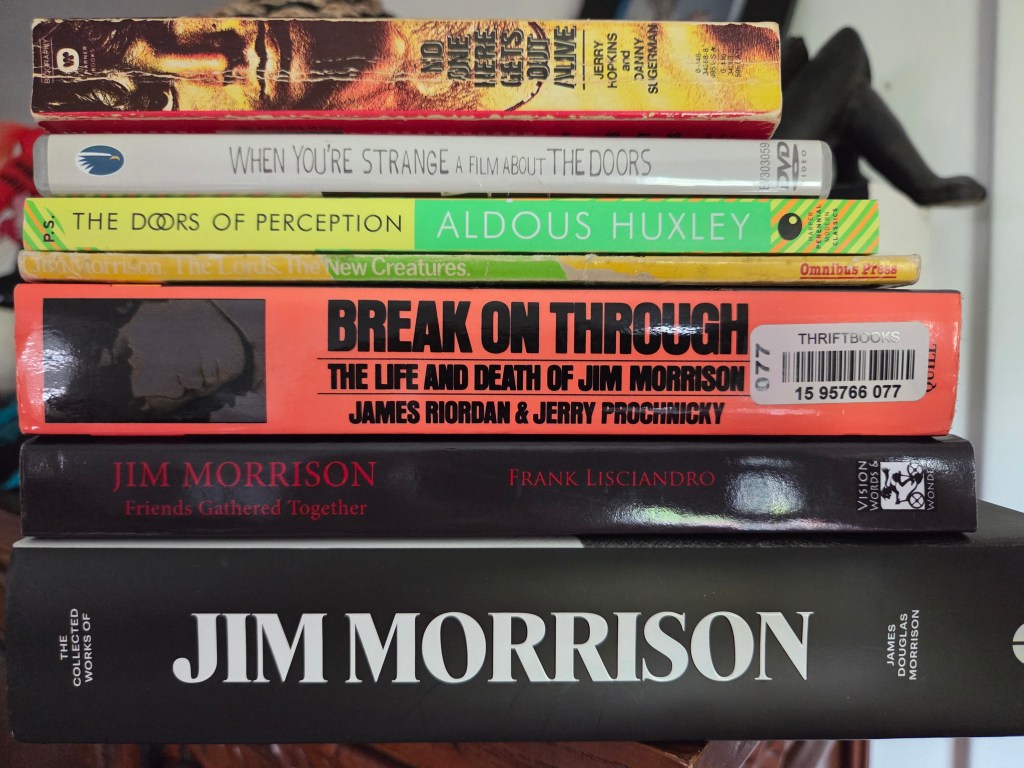
I cannot find it now, but I read something not long ago that asked if bands like The Doors still matter a quarter of the way into the 21st century, particularly to young people. I have no idea, but the music still matters to me. If we’re even asking that question 60-plus years after they formed on that beach, they probably still have a little cultural cachet remaining. Their influence within the music industry itself remains a substantial achievement, even beyond selling more than 100 million albums.
Music changes, evolves, dies and is reborn. Not everyone loved The Doors or Jim Morrison. For example, the éminence grise music critic Robert Christgau, in an essay published years ago but in this century, called Morrison an “egotistical degraded existentialist idiot” and reminded us that late Creem magazine rock critic and slob (éminence greasy) Lester Bangs called him “Bozo Dionysus.”
Personally, I enjoy much of Morrison’s poetry, a lot of which became Doors song lyrics or spoken-word interludes. I enjoy him reading some of his poetry on the An American Player album that the band added music to for a 1978 release. Some of his poetry I find juvenile or cringe. But we can say that about most poets. Me, I hadn’t written a decent sentence by age 27.
Other notables were big fans, and celebs continue to visit his Paris grave as a sort of pilgrimage perhaps for Dionysian satori. Lana Del Rey sang about him. In 1986, Hunter S. Thompson wrote a brief item about his massive satellite dish at his mountain lair in Colorado, with “The Bird” as he called it scanning the heavens to pick up a wild array of things broadcast into the cosmos, most of it crap. But not everything:
“But you don’t get a lot of Jim Morrison. That is what we call a Special—straight black and white footage of Crazy Jim on stage in the old days, with a voice like Fred Neal’s and eyes smarter than James Dean’s and a band that could walk with the King, or anybody else. There were some nights when the Doors were the best band in the world.
Morrison understood this, and it haunted him all his life. On some nights he was noisy and lewd, and on others he just practiced —but every once in a while he would get it into his head to go out and dance with the big boys, and on a night like that he was more than special. Jim Morrison could play music with anybody.
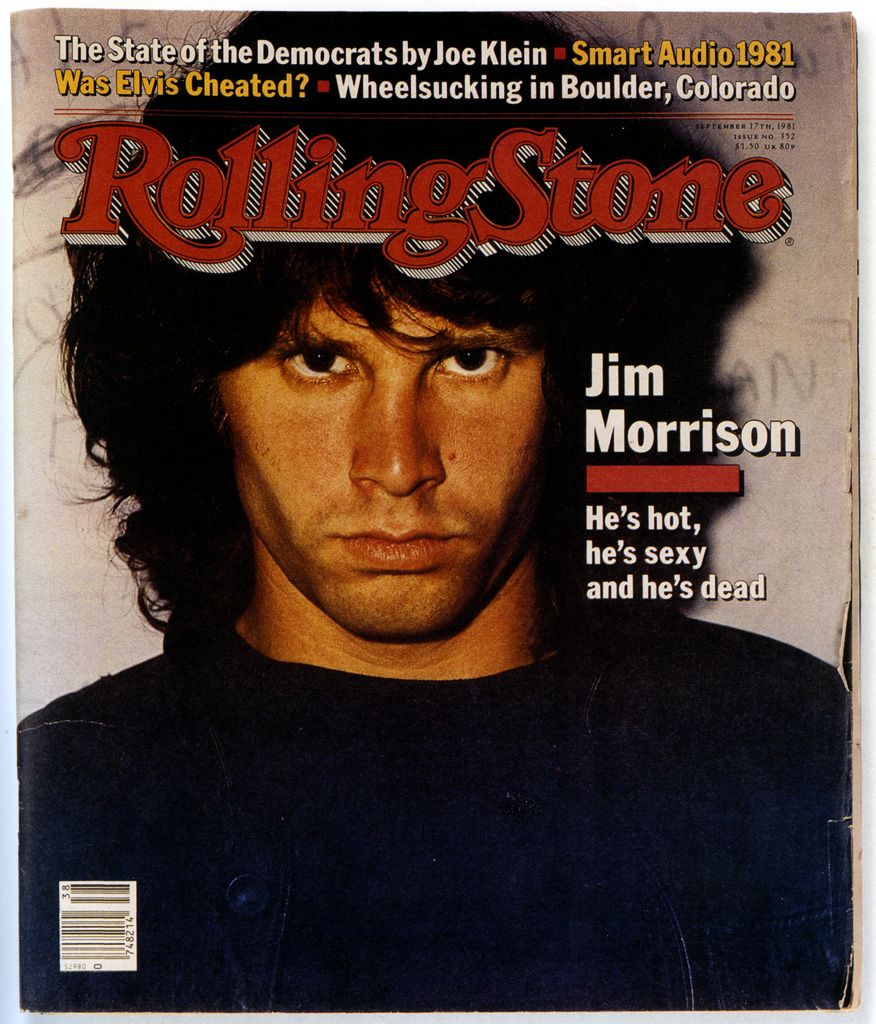
The Doors seem to cycle (perhaps revolve) in our culture. They were a non-entity in the years after Morrison’s death, which included two poorly received Doors albums as a trio, and the remaining members’ solo work never approached what they did together. Then Francis Ford Coppola’s “Apocalypse Now” in 1979 brought “The End” back into the mainstream and kicked up renewed interest in the band, fueled further by the above-mentioned Morrison biography, followed by a 1981 Rolling Stone cover that read “Jim Morrison: He’s hot, he’s sexy, and he’s dead.”
Olive Stone’s 1991 gonzo Morrison caricature biopic “The Doors” re-injected the band and their lead singer into the popular imagination of many Boomers, Gen Xers and young Millennials.
There’s now a whole cottage industry of Doors/Morrison specials, live album bootlegs, merch, and books – anyone that vaguely knew Jim Morrison and the band has put pen to paper over the past 40 years. We know now that Morrison was much more than the arrogant, cruel, pretentious drunk in leather pants portrayed in Stone’s movie (preternaturally acted and sung by Val Kilmer, to his great credit). The flaws and demons were very real, but the consensus was he was mostly brilliant, deeply read, and extremely funny, and when he was away from crowds and booze he was a sweet, gentle, and shy man. Unfortunately, he was not always away from crowds and booze.
His words and the band’s sound have been with me for almost 40 years now. I’m on the doorstep of turning 52. Morrison is forever 27, a lascivious spirit in the realm of myth and legend and it’s hard not to wonder what he’d be like in 2026 at age 82, what he’d have done, what music and poetry and movies he’d have made. Would he have decayed into a sloppy reactionary drunk like Jack Kerouac? Or aged into a boring elder statesman of music and meaning, sitting atop a mountain dispensing hoary wisdom and profound bullshit? Would he be a Bob Dylan, who’s still touring and putting out music at age 84? Would Morrison have sold his music and words to Madison Avenue?
Of course, the classic Jim Morrison question remains: Is he still alive? Since the day he died on July 3, 1971, there have been rumors and theories to this day that he faked his death to escape fame and legal troubles. No one apparently saw his body, and there was no autopsy, before burial in Paris’ famed Père Lachaise Cemetery alongside the likes of Oscar Wilde, Sarah Bernhardt, Balzac, Collette, Chopin, Molière, Edith Piaf, Gertrude Stein, Richard Wright, and Proust.
That’s some pretty fucking good company to spend eternity with, no? Morrison surely would appreciate it. He earned his immortal place with such luminaries. And yes, I think he’s dead but with a caveat: While I’m not prone to conspiracy theories, Morrison would be the lone case where I wouldn’t be 100 percent surprised if it was a genuine faked death (which gave us Eddie Wilson). Maybe he ran off to Tangiers or Bangkok or a Tibetan ashram to write poetry under a new name and life, but I doubt it. Odds are, he OD’d on junk and died in that third-floor Parisian bathtub at 17 rue Beautreillis just as the police report says. Occam’s syringe, I suppose.
Today, the Doors’ early sound evokes teenage memories for me of chilly late autumn afternoons when the fading sun hangs low in the dying light of the western sky, the skeletal trees are near leafless, and the mood has a vague hint of menace as we hunker down, in our coats and blankets, and dream of spring. It’s ephemeral and mournful but also sometimes bright and carnival. It’s been my soundtrack.
Junior high, for me and every other human, was a surreal, awkward time. Growing and maturing and struggling to figure out who we are and where we’re going. First love, first kisses, and all the heart-pounding thrills of middle school hormones fully unleashed. Often, we have our own musical soundtrack for that time in our lives, and mine was The Doors in the 1980s.
Their music would be playing while I studiously ignored my homework, instead voraciously consuming novels and history books, playing games, or otherwise fucking around while listening to tunes such as “Not To Touch the Earth” and “Spanish Caravan” played on cassette tapes via my boom box or my yellow Sony Sports Walkman. I must have listened to hundreds or even thousands of hours of Doors music on that Walkman while cutting the grass at our suburban Cincinnati house when I was in middle school and high school. I wore out a couple of those tapes. Eventually, I sold them all for a buck a piece in college for food money and trashed the Walkman – dual regrets, even if I later had CDs and then everything digitally to stream on my smartphone, laptop, or in my car.
My interest in The Doors has waxed and waned over the years. While I’m firmly a Gen Xer, my musical tastes remain heavily Boomer – Steely Dan, Lou Reed/Velvet Underground, Jimmy Buffett, Bowie, Fleetwood Mac, Billy Joel, Chet Baker, Queen, Patti Smith, Pink Floyd, Dylan, Rush, ELO, Police/Sting – while still making room for plenty of modern or modern-ish stuff. The Doors remain the backbone of my musical tastes and remain a comfort because they evoke mostly good memories. Also, no one else sounds like them.
An upside of my decades in newspaper journalism was the opportunity to interview celebrities, and in 2008 I spoke briefly by phone with Doors’ guitarist Robby Krieger (who at age 20 in 1966 wrote his first song, “Light My Fire” which is like an MLB rookie belting a grand slam in his first career at-bat in the majors). Our brief call was ahead of a suburban Detroit show by him and Manzarek. Eighteen years later, I cannot remember if it appeared anywhere but in a Myspace post. I had a ticket to the show, but circumstances prevented me from attending. Below is what I was able to salvage in my personal archives:
This is a raw version of my short interview with Doors guitarist Robby Krieger on Friday. I’ve been a big fan since about 1987, so this was pretty cool. Not even sure if it’s going to run in Crain’s, since we’re a business publication, but it might in our “Rumblings” section that’s a bit more laid-back. I didn’t include his comments on missing Jim Morrison, or that the other three band members thought of themselves more of an “underground” band than a mainstream act, while Morrison wanted to be The Beatles, according to Krieger. No room for everything.
It’s been nearly 40 years since The Doors last played Detroit, an epic May 1970 Cobo Arena concert that eventually became a 2-disc live CD in 2004.
Two of the band’s surviving members were in town Friday to play a show at the Emerald Theater in Mt. Clemens. Guitarist Robby Krieger and keyboardist Ray Manzarek have been touring since 2002 with a band now called Riders on the Storm, a name taken from a Doors song.
The original band first played Detroit in 1967, said Krieger, who wrote Door’s signature hit “Light My Fire.”
“That was crazy. Probably the wildest audience we had up to that point,” he said.
Ex-Fuel frontman Brett Scallions handles the singing in place of the enigmatic Jim Morrison, who died in 1971. The new band in recent years has played three shows at Clarkston’s DTE Energy Music Theatre and one in May 2007 at the Emerald.
“I prefer playing the smaller places. Those big places (like Cobo), it’s harder to fill it up with sound,” said Krieger, who’s again using a 1967 Gibson SG guitar as he did with the original Doors.
The band tours far more today than during the 1960s, something Krieger attributes to not having the unpredictable Morrison around.
“It wasn’t so easy to go out with Jim. He’d get a little crazy after a few days,” he said.
And the music business today?
“It’s totally different. It was a lot easier to get screwed back then. We didn’t know anything,” Krieger said. “Back then, we had nothing. We never had a tour bus. We had four guys and a roadie. I don’t know how we made it. I never thought it would last. I always thought I’d have to get a real job,” he said, chuckling.
Because the band played well over their allotted time at Detroit’s Cobo Hall in 1970, the venue banned them. It was a performance worthy of its own album, and a far cry from their disastrous performance at a University of Michigan homecoming concert in nearby Ann Arbor three years prior.
In November 2011, while living in downtown Detroit, I was fortunate enough to have a friend that had extra tickets to Krieger and Manzarek playing at The Fillmore theater on Woodward Avenue. We were already drunk from boozing at my beloved Vivio’s bar in Eastern Market and ended up showing up at the concert after it had already begun. How very Morrison!
By then, the band was using a Jim Morrison “tribute” singer named Dave Brock as lead vocalist. He looked enough like the Lizard King/Mr. Mojo Risin in the dark venue and sounded and acted enough like Morrison to not be a distraction. Vocals and stage histrionics are just part of what made a Doors concert, the rest being the music itself. Especially the sound of Manzarek’s electric organ (and he simultaneously plays a Fender Rhodes piano bass with his left hand, since the band never used a bass guitarist outside of studio sessions). Krieger’s guitar also is a critical component of the band’s sound.
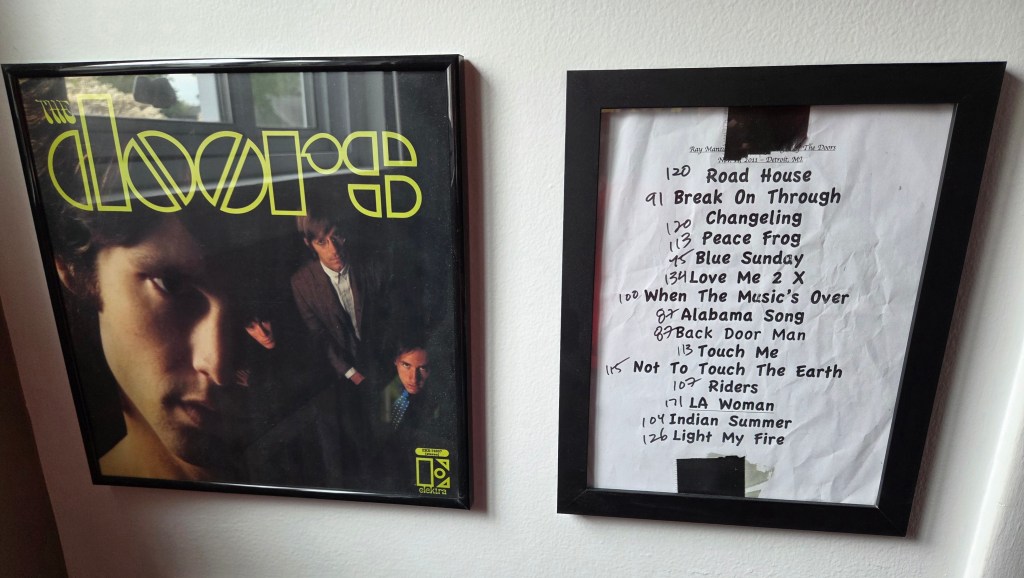
That night, I was as close as I could ever get to a live Doors concert. Seeing and hearing 50 percent of The Doors live was better than zero. For a couple of hours that night, I was in a manic, blissful state of mind after finally seeing as much of The Doors that was possible without supernatural assistance. And to cap it off, after the show, a roadie gave me the setlist that had been taped to the floor. It’s framed on a wall in my house now.
In more recent years, as chilly springtime rains finally give way to warm and sunny May days, I find myself rewatching the Olive Stone movie and playing Doors music while I’m in the shower or driving or sitting down to write. And I still listen to their music while cutting the grass, only now streamed via YouTube Music on my phone rather than via the ancient long-lost Walkman.
As different as the world is today – Jim Morrison would have been a Tumblr and LiveJournal legend before repeatedly and violently swearing off Twitter – the past still echoes in violent ways. America is mired in another stupid, useless and immoral war. The president is a bloodthirsty criminal. Culture and capitalism remain in an eternal death embrace. Mass media bombards us 24/7 with bullshit. Advertising seeps into every aspect of our lives. Segregationists are amok as our institutions fail us. People crave rebellion and revolution and something new and better. The world is on edge. As Morrison sang, the future’s uncertain and the end is always near.
Strange days, indeed.
-30-


Leave a comment